Friday, August 14, 2015

Yard sale
August 11, 2015

"Are you here for the yard sale?"  That question was posed to us as we checked into our RV park near Crossville, Tennessee, and left us feeling quizzical.

Our confusion about the idea of coming to camp because of a yard sale was allayed when we ventured out Saturday morning to go fishing.  Turned the corner and came to a stop . . . in the highway . . . for a long time, finally proceeding in stop-and-stop traffic for miles.  We had arrived unsuspectingly smack-dab in the midst of what is billed as the world's longest yard sale (Eat your heart out, Shannon).

For two decades, this has been happening along the US 127 corridor, now expanded from 450 miles by an additional 180 miles, it now stretches from the Ohio/Michigan border to Gadsden, Alabama, in a serpentine route.  For four days in August, the route is lined with roadside sale after sale, bazaars, commercial encampments, all in a fair-like atmosphere - from modest residential offerings to packed parking lots filled with vendors, thousands of people vying for parking places.


So that was why it was hard to find an RV space . . . and why the place cleared out afterward.

Fishing, hopefully . . .

After exhibiting the utmost in patience by creeping slowly along whilst all those erstwhile shoppers inched their vehicles in and out of their niches along the road and carted their bags and boxes of finds through traffic (it's not like we could extricate ourselves from the car conga line), we made our way to the Cumberland State Park office to purchase fishing licenses, our big splurge to celebrate staying in one state long enough to justify it.

Sorry, so sorry, but the computer went down before our permits could be issued.  Just go on down the road to the sawmill market, the clerk suggested; our licenses could be bought there.  

Sorry, so sorry, said the Sawmill Market man: I don't sell fishing licenses.  Head over to the corner market.

Sorry, so sorry, said the corner market lady after working hard to remove a lot of detrius from atop the license machine hidden on a back shelf; the printer won't work.  Hmmm. . . maybe we weren't supposed to fish?

Unable to help ourselves, we inquired at a convenience store miles away that was on a river road.  Sorry, so sorry, they don't sell them.

Persistence does pay off, though - the fifth place we tried not only sold licenses, their computer worked, their printer worked and they presented us with 10-day fishing permits, which we utilized in several lakes, rivers and creeks.

Cumberland Plateau . . .

Truth be told, I have stood on the bank of so many bodies of water in the past few days that one might as well be the next one.  There was the Obed Wild & Scenic, the Emory, Clear Creek, Watt's Bar, Fall Creek Falls Lake, to name a very few.  We caught fish in some, others not so much, but all were interesting in their own way.

We wandered back roads through the Catoosa Wildlife Management Area and a multitude of other Tennessee backwoods regions, sometimes going in circles, but always marveling at the beauty of the landscape.  We did quite an explore of the Cumberland Plateau, an intriguing region that will surely draw us back.


 Fall Creek Falls . . .

A couple of days later, my legs are still sore from our waterfall quest on Fall Creek.  The initial stretch was moderate, although rough enough over webs of tree roots and rocks that I was astounded when we met a blind woman and her companions returning from their hike.  She utilized her cane ably and followed directions as she slowly and smilingly made her way.  I told her she was my hero for making that trek.

A blind woman makes her way back from a hike to "see" a waterfall.

When we gained our vantage point of the primary waterfall, a spectacular sight, we realized that the trail continued to the base of the cascade; therefore onward we must.  The climb was steep, as it needed to be, and bouldery, a clamber that was rewarded as we enjoyed a different perspective, downside up.

I photographed several waterfalls, beautiful every one, from upside, downside, every side I could, and not a one of them begins to convey the sight.  At 256 feet, Fall Creek Falls is the highest free-falling waterfall east of the Mississippi.

Our reverie was interrupted by a Tennessee gully-washer that had been threatening for a while.  Taking shelter under a large rock overhang, our intention was to wait it out, but patience grew thin and we ventured out as the storm lightened.  

Chris' prophetic words, "It's getting darker; I hope it doesn't rain again before we get out", were scarcely uttered before it commenced to downpour, continuing for the remainder of the hike.  I tried to shelter the camera under my shirt and by hunching over it slightly; somehow, it came through unscathed despite we two bedraggled beings becoming drenched.

It soon became clear that soaked clothing does not dry quickly in environments such as that as it does in more arid climes.  Our (dis)comfort level precipitated by being clad in sodden clammy clinging clothing precluded much more in the way of sightseeing on that afternoon.


 Somewhere during that day, there occurred a crossing, two actually, of a suspension bridge swaying precariously over a deep gorge, a very long bridge that insisted upon acting as if unseen persons of villainous intent were jumping up and down somewhere along its length, causing it to feel as if it were about to loosen from its anchors and plunge anyone upon its unsteady span to be dashed upon the rocks far below.

I accused Chris of such activity; however, it was obvious he was innocent (then, at least).  The bridge was bad enough that some of higher intelligence who began a crossing turned back before proceeding very far.  We, however, ventured across the entire span, necessitating our return the same way, except that on the return, we were in the midst of a thunder storm, thus stuck out in the middle of a gorge while lightning flashed overhead.

Even with only two on the bridge, it felt as it were about to buck us off, no matter how carefully we trod.

 Spring Lake, a swan? . . .

The Spring Lake RV park was a nice surprise with its pleasant sites on the pond banks and swings, tables and grills at each site.  I was immediately lulled into a nap by the fountain after watching a kingfisher repeatedly diving into the water.  Three resident wood ducks were fun to watch, although the one with three young soon became the mother of only two.


And that swan out there . . . not moving . . . was disappointingly fake, a ploy to warn off geese that might want to hang out there.  I was told by a fellow camper that nesting swans are known to be aggressively territorial, thus deterring geese from choosing those places to raise their ruckuses.


 Seals . . .

We were not ancestor hunting at that spot; our many Tennessee forebears resided primarily in other sections of the state, but I called a halt to our forward movement nevertheless when I spotted a turnoff for a Seals cemetery, that being the name of my three greats grandmother who was from Tennessee and whose ancestry I know little about.

We saw no markers that could be ancestral, but I have little doubt that kin are buried there. 

As is absurdly obvious to anyone who knows me, I am passionate about knowing my ancestors (and everyone else's, for that matter).  To locate historical records relating to the relatives is interesting; however, actually being in the places where they lived is positively transporting for me.  Seeing names on a map and reading about the locations is one thing - being there and seeing the landscape they saw brings a whole new perspective and understanding.

Bunting! . . .

During our wanderings there, we added several birds to the trip list: eastern kingbird and Savannah sparrow, but by far, my favorite was the indigo bunting.  What a startlingly beautiful bird it is!  As we left a non-productive fishing spot, we stopped to see what exciting finds might be on an island rookery we were passing.  Nothing new out yonder, but the bunting landed on vegetation in the forefront of my line of sight.

Adventures with Petey . . .

Just before we left North Carolina for the second time, we fulfilled an earlier promise to Petey, Dad's caregiver, to troop off in the woods with her to fish in a mill pond.  That was a fun couple of hours: I was the only one willing to go out on the dilapidated collapsing dock and I was the only one who caught fish.  Chris got hooked up with a monstrously huge snapping turtle that was too heavy to land, and Petey carted home a nice stringer of bream to fry up for supper.


Many a fine, some not so fine, abode has been abandoned in those Tennessee hills.
Gasoline, the non-ethanol type, was down to $2.01 before prices began to climb again.  The ethanol additive is definitely frowned upon in those parts.


Saturday, August 8, 2015

Kin present & past
August 4, 2015

Wending our way back to Tryon to spend a few days with Mom again leaves us with nice memories of relatives - the current kind and the very long-ago ones. 

Still in Georgia before we returned to North Carolina, we greatly enjoyed spending time with two of Chris’ first cousins and their families.  We were honored that the clan gathered for our visit, and what a gracious and cordial group they were. Very fun also to be with the children who were just as loving as could be; interesting that as soon as Chris began to play the piano, they grouped themselves in the room to listen.

There's a real rogue's gallery!
Our day with the family was a welcome respite from being on the road, lovely to relax and revel in that welcoming family atmosphere - the bonus was the feast that left us more than sated.

We had chosen Bishop, Georgia, for our stay to be centrally located for visiting with our kinfolk and to be do ancestral research in counties the other direction. 

In the course of our research, we became very well acquainted with the veritable web of two-lane byways that criss-cross that region.  The area has a wealth of delightful small towns filled with well-kept enchanting historical neighborhoods - one after the other, each one calling to me to settle there to sit on an inviting wrap-around veranda and sip sweet tea.

With all the hiking we’ve been doing, I probably could have lost some weight were it not for the gallons of sweet tea I have consumed in the meantime.  And then there’s the buttermilk pie - wowza - thank goodness that has tempted me only once, but a memorable once it was - at Yesterday’s Cafe in Greensboro.

We also ventured to Athens, the home of the University of Georgia, a very happening place, hundreds of attractive historical buildings, commercial and residential, and bustling with tourist and student activity alike.

Revolutionary . . .

Knowing that our Patrick Vance participated in the Battle of Kettle Creek during the American Revolution, we went to War Hill, the site of that engagement.  It is a little-known, little-visited place, a lonely prominence at the end of a long gravel road through the forest.  One other couple arrived shortly after we did: an interesting encounter - he flies the Memphis Belle for the Commemorative Air Force.

I can never quite wrap my mind around what Revolutionary times must have been like for individuals.  I tend to think of it as evolving from political discussions with friends to disagreements, arguments and eventually to out-and-out warfare between neighbors, whether they were wiling to fight for independence from England as Patriots or sided with the home country as Loyalists.  Surely the latter group might have viewed the other as traitorous, and just as surely, it had to be terrifying as a Patriot to think of the odds they were facing to go to war against British troops.

In the case of the encounter at Kettle Creek, no British troops were involved.  Patriot militias, of which Vance was a part, were deployed to stop the march of Tories who had been recruited to join the British.  The battle prevented them from joining the regular troops and was decisive in preventing English domination in the Colony of Georgia.


War Hill memorials to the American Patriots who fought at the Battle of Kettle Creek.
 The battle is worth reading about: it is probably more representative of what transpired during the American Revolution than are those better-known engagements.  When all was said and done at War Hill, the Loyalists had 70 killed or wounded and 150 men captured.  Some of those who were captured were later convicted of treason and hanged.  Nine of the Patriots were killed and 23 wounded or missing.

Settlement Road . . .

The militia advance toward War Hill as they pursued the Loyalists was via what is today a seldom-used two-track through the forest.  We were able to drive on a part of it, following the same route that my ancestor marched.  It was an exhilarating experience to follow in his footsteps, so to speak.

Settlement Road, so named for its access to a tiny back-woods village near Hammett's Farm, where 1770s British supporters stole cattle to butcher on War Hill before they were ambushed and defeated by American Patriots.
Burials none . . .

We came away from our library research time with paper enough to keep us busy for quite a spell analyzing and charting the family history material.  One of our finds was the location of property owned by our Owen ancestor: it was described as on the east bank of the Oconee River just below the big shoal, which is now called Barnett Shoals.  That river drop-off marked the final navigable place upstream on the Oconee.

We typically attempt to locate ancestral burial sites and to place flowers to honor them; however, we have not found Patrick & Sarah (Harrington) Vance, although they may have continued on to Kentucky, nor William & Drucilla (Echols) Owen, whom we think are in Georgia.  It is also possible that some of their parents also went to Georgia from Virginia.

We walked one churchyard that dated early enough - 1780s - for them, and it has an Echols memorial in it.  We do know that some of Lydia's Echols kin remained in the area; that stone is most likely a memorial for relatives, but none of the individual markers were legible, so we can't be sure.

The church itself was striking, amazingly preserved for one so old that is no longer in regular use, although it is evidently kept up for special events.


Scull Shoals . . .

How permanent we think we are on this Earth; yet we visited another example that illustrates just the opposite.  Scull Shoals was a bustling community on the Oconee River.  The village was tucked up on the river bank where its mill could be powered water.  Workers  accessed the mill via a beautifully constructed arched brick bridge.

This picturesque brick bridge arches over the canal that carried water to power the 1800s mills at Scull Shoals.

The Oconee there was bridged by a toll road, now nothing left but an unrecognizable pile of rubble - a mid-stream rock pier.

Portions of the warehouse's walls, grown over by leafy vines, and collapsed piles of brick marking the site of the supervisor's home are virtually all that is left of this once-lively enterprise and town.


Many communities have come and gone; however, I am surprised at how quickly Scull Shoals melted down into little more than a grassy forest clearing.


It was populated as late as the 1930s, yet archaelogical excavations are necessary to find its remains.

Covered bridges, birds . . .

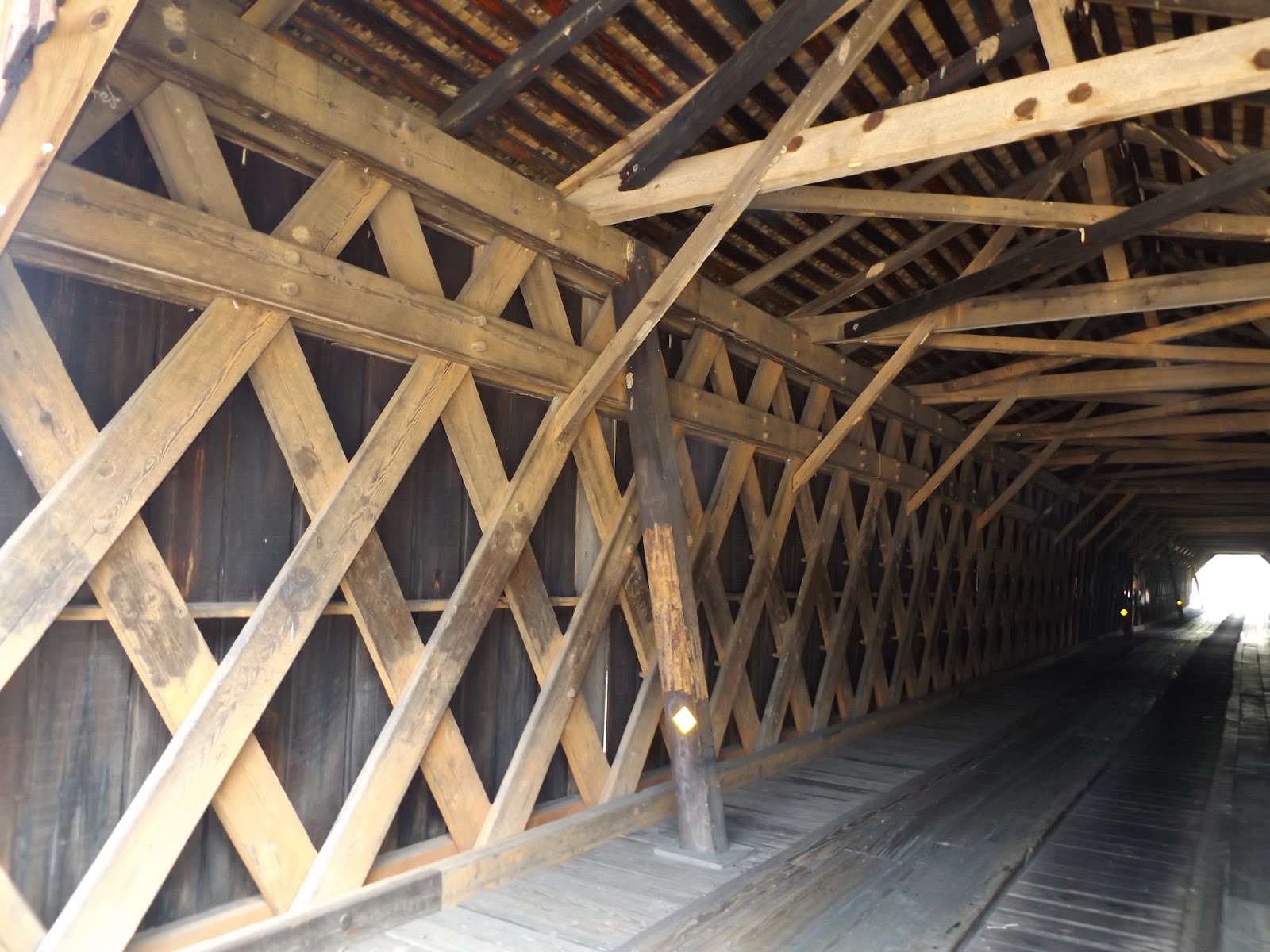
Another covered bridge - this one from 1897 constructed to access the Elder Mill, but moved from its original location over Calls Creek in 1924 when the road was rerouted.


It was interesting to see how the Elder Bridge's framework was joined by wooden pins.  The chalk notations evidently were made when the structure was taken down for moving.
It gets increasingly difficult to identify birds that we haven't already seen on this long foray across the country.  In Bishop's environs, we spotted gray catbird and chipping sparrow.  During a long country road wander, a lone killdeer opted, like the proverbial chicken, to cross in front of us; otherwise, we would not have gotten him, and that led my eye to who was flitting around over a grass pasture where we saw our first eastern bluebird perched atop a fence post.

When in doubt, it is most helpful to stand belly-deep in a pond and watch the world go by.
I like this a-lure-ing mailbox.
I have no idea what this flowering vine is; it was growing near War Hill.

Saturday, August 1, 2015

Back in Georgia, back in time
July 31, 2015

Moving northward, we are again in Georgia and seeing a whale of a lot of rural countryside - lovely, rolling forested hills and open green grassy pasture land - all at a relatively higher elevation than we’ve been at, somewhere in the 500 to 800 foot range.  Granted, it is very different than our mile-high status at home, but it gives a person a bit more variety. 

There is also some slight change as far as nighttime cooling-off temperatures, too: we are now getting down into the mid-70s for lows - not optimum but a relief nevertheless.

This section of the Peach state is in the Piedmont, that vast area between the Appalachians to the northwest and the “fall line” where the land drops off to the seacoast plain.

The Georgia bight . . .

I had never heard of a bight, therefore was unaware that Georgia had one, but now I have and now I know.  The Georgia bight is that place along the Atlantic seaboard where the coast turns inward in a long sloping westward direction.  In learning about the Georgia bight, I was informed that being on the seashore of Georgia puts a person longitudinally straight south of Cleveland, Ohio.  No, I didn’t believe it either, had to check on the map for verification.

Colonial times, Eagle Tavern . . .

Georgia is proud of its status as one of the 13 original American colonies; in my continuing ignorance, I never gave much thought to its history as it relates to American indpendence from Britain.

Roaming around in the Franklin & Wilkes counties region as we have been quickly set me straight on that.  We were barely out of the RV park (a nice family-run woodsy place, as it turns out) before I called a halt to our forward progress.  First stop was a welcome center manned by a most congenial and helpful fellow.

I asked about the hours during which a person could see the historic Eagle Tavern across the road, at which our self-proclaimed guide, Alex, offered to open it up for our personal tour.  What an amazing place - constructed in 1801 or possibly before, the inn was enlarged over the years.  Because of those additions, the original four-room (two up, two down) structure was somewhat protected from the elements.  When the later portions were removed, it was possible to restore the striking building to its original beauty.


The Eagle Tavern before restoration; it would require some vision to see the potential.
The Eagle Tavern with the additions removed and the original structure restored.

The Eagle Tavern as we saw it.


For a price, travelers would be afforded a shared space on an upstairs bed.

Part of the 19th century Eagle Tavern ledger was found in this trunk.


Washington, Wilkes, weightlifters. . . 

Once again taking a look for ancestors, we headed for the library in Washington, county seat of Wilkes, where our Echols, Owen and Vance ancestors spent time not too long after the American Revolution.

We knew that our Patrick Vance fought during that war for independence and was in the Battle of Kettle Creek, but our knowledge went little further than that.  He was married to Sarah Harrington and was the parent of our Lydia Vance who wed Major Ezra Madison Owen.

Although 18th century records from the Georgia wilderness are scanty and/or destroyed, we managed to find a few tidbits about the family, more about the Echols branch, some of whom remained here when ours moved on (why is it that my family lines are always the ones who keep moving?).

One side of Washington's quaint downtown burned in the late 1800s, there remain around the courthouse center a number of buildings from earlier - one even dated 1815!


As I was preparing to do a few photographs, we noticed crowds beginning to gather, and it seemed fairly obvious that they were not there on my behalf.  Of all the crazy things we've happened into, this had to be the most unusual:  a "Lift-a-thon" was about to take place.  Curiosity piqued, we must remain to witness the event.

Evidently, the high school football team gathers annually downtown to do some sort of weight-lifting event in an attempt to better any previous feats accomplished in the gym, and townsfolk gather to cheer them on.  Although I think there was some system in place, it gave the impression of semi-organized chaos.  Not sure, but it's possible that my mentally straining along with them helped a bit.


Callaway Plantation. . .

Finishing our short library perusal allowed us just enough time to have a tour of the Callaway Plantation.  The big house, a Greek Revival mansion, was interesting; however, I was more intrigued by Aristides Callaway's earlier abodes.

 Two older structures on the property were contemporary with my ancestors in that place, thus giving us a look at what surely their homes would have been like.  The log cabin was built about 1785 and the gray house circa 1790.


Franklin County, library, Mexican food . . .

A wander around Carnesville, the Franklin County seat, had us wondering why we couldn't find a library, typically easy to locate in small towns.  Turns out they don't even have one, which left us flabbergasted, even more so to learn the entire county has only one library, and it is not much to speak of.  The librarian there was anxious to assist us and very helpful, as much as one could be when the local history section consists of no more than a half-dozen tomes.

Lunch time found us just about as bereft of eating establishments as libraries.  Chris finally convinced me that we should try Georgia Mexican food, that genre being the only restaurant in sight.  Nice place, great service, excellent prices, tasty salsa, but oh that chile relleno!  What I have always thought was a standard entree turned out to be something else entirely. 

I shall try to describe it:  begin with a glop of some gruel-like substance, possibly some ground meat in a thick sauce of unknown origin, place a very small bit of a mild green chile over it and top with melted cheese and there you have it.  I knew better; will we never learn?

Watson Mill Bridge . . .

This country is criss-crossed by a multitude of two-lane winding roads that wander up and down and around until I have no idea where I am nor in which direction I am traveling.  On one such back road traverse, we made a stop to see the Watson Mill Bridge. 


 It seems the Watson Mill, once a fixture on the South Fork River, is no more; however, the covered bridge there is said to be the longest such span in Georgia at 229 feet.  An 1885 one-laner, it is interestingly constructed - supported by a town lattice truss system held together by wooden pins, so states the accompanying brochure.


The place is a state park; a number of people were cooling off in the shallow water, which would be considered tepid except in comparison to the air temperature.  Being of a perverse nature, we opted for a two-and-a-half mile hike through the woods.

This forest offers a shady canopy but is of an entirely different nature than the sub-tropical jungle-like places we were in down Florida way.  The respite from sunshine did not seem to moderate the termperatures at all, but we quite enjoyed our walk, nevertheless.

It doesn't take much exertion, usually none at all, to break out in the sweaty shiny Southern skin sheen, and this was no exception.

Our RV park outside of Bishop has two nice large lakes and is currently housing pipeline workers who have been working here for a couple of years.  Chris talked to one of them who, like us, worked for a spell in Midland, Texas, and who, unlike us, had the sense to leave there within a couple of months of arriving.