Friday, April 1, 2022

The one that really got away, and Palm Canyon

Martinez Lake . . .

Yet another body of water to check out - Martinez Lake, impounded by Imperial Dam - and one that was unique in that it is mostly inaccessible except by boat.  In fact, it seemed perfect to explore by kayak with its many finger channels winding through reed-covered shorelines.  On our next visit, I would like to rent a small motor boat to fully explore it and the river's main channel.


A fishing fiasco . . .

We found only one place to fish that lake - a dock that reached out into a large open water - so that's where we began our ill-fated fishing experience.

It began innocently enough.  Each of us were using two rods with different methods.  "Watch my poles", the seƱor requested, as he headed for the truck to retrieve something or other.  Not an uncommon thing to ask, and I was happy to comply (but I suspect I may never again do so).  

As I kept my peripheral attention on his angling set-up, I noticed a sudden ruckus to my left.  Wow, I rushed over to where he had been fishing only about six feet away and grabbed his rod that was dancing quite an enthusiastic jig.  I hooked the fish and began to reel it in, except that he had left his drag open and the line was completely snarled around the reel.  As I worked on sorting out how it was entangled and how to free it, I was trying to deal with what was obviously a large fish on the line.

At that point, I became aware of a commotion back at my station and turned just in time to see the splash as my rod and reel hit the water after being pulled up and over the railing where it had been leaning!  It happened so fast that I could only stand and stare at the empty space where my fishing pole had been.

Eventually, the seƱor ambled on back, untangled the mess and almost landed an estimated five or six pound catfish.  It was too heavy to take out of the water.  Didn't compare to the monster at Port O'Connor, but a hefty catch, at any rate.  We couldn't help but wonder at the size of the one that absconded with my rod and reel.

Badlands . . .

As we explored the countryside, we came to an area dubbed The Painted Desert.  Seemed the perfect time to get in a scramble out through some intriguing landscape.  We saw nary another person, while fully expecting to encounter a burro or many.  There was ample evidence of their presence, and I was disappointed never to spot any.  The hike was invigorating and interesting even so.


A military presence . . .

The region is surrounded by Army proving grounds and various military installations.  Two weather balloons were visible near us, and we heard bomb explosions in the distance, as well as a variety of military aircraft overhead.  It was impossible not to think of what is happening in Ukraine.

Palm Canyon . . .

Just about every one of the million times I've ridden down Highway 95 and passed the turnoff sign for Palm Canyon, I have reiterated my desire to go there.  For the record, I envisioned the experience as a stroll along between high rock cliffs culminating in a palm-shaded and -cooled grove.

As it turns out, the reality was far different from my imaginings.  I have long been in awe of the many rugged mountains ringing those wide-open desert plains; that admiration is only enhanced by every visit.  I cannot get enough of how the sun light and cloud shadows accentuate every crease and crevice in the rocks.

Massive and majestic Signal Peak in the Kofa Range is where the trees are nestled snugly in a south-facing crevasse.


It is possible to get right among the palms, the only place in Arizona where native California palms grown in their native habitat; however, we viewed them from across the ravine as do most folks, not that we encountered many others during our climb.

A trail of sorts has been scrabbled out to wind around the bouldery slope, and just in case a person is too busy watching their footing to notice when the trees come into view, a sign has been posted.  I had to laugh about it, but it actually would be easy to miss them if you weren't keeping a close eye out.


I've read that there are about a hundred of them; we also spotted a few singles and pairs in other vertical cracks in the solid rock face.


Next time, we will try the trek down into the canyon and back up the other side, but I admit I'm not overly  excited about doing it.  It's another of many things that I might pass up, but end up being happy I went ahead and did it.

Even without the attraction of the fascinating trees surviving in their niche (don't we all feel comfort in our own niche!), the jaunt would have been well worth it for the incredible beauty offered by nature.  A bonus was the ocotillos were opening blossoms with a hue that is one of my all-time favorites.


Spiraling . . .

If it were not for the seƱor's penchant for google-earthing, we would never have known about the Koh-Kopelli spiral labyrinth that has been painstakingly crafted on the desert varnish ground surface by an anonymous being.  Even after spotting it in the overhead photos, it was not easy to find.  We were happy that we took the time to do it; we walked the entire spiral, a lengthy and time-consuming activity, and felt very good about it.

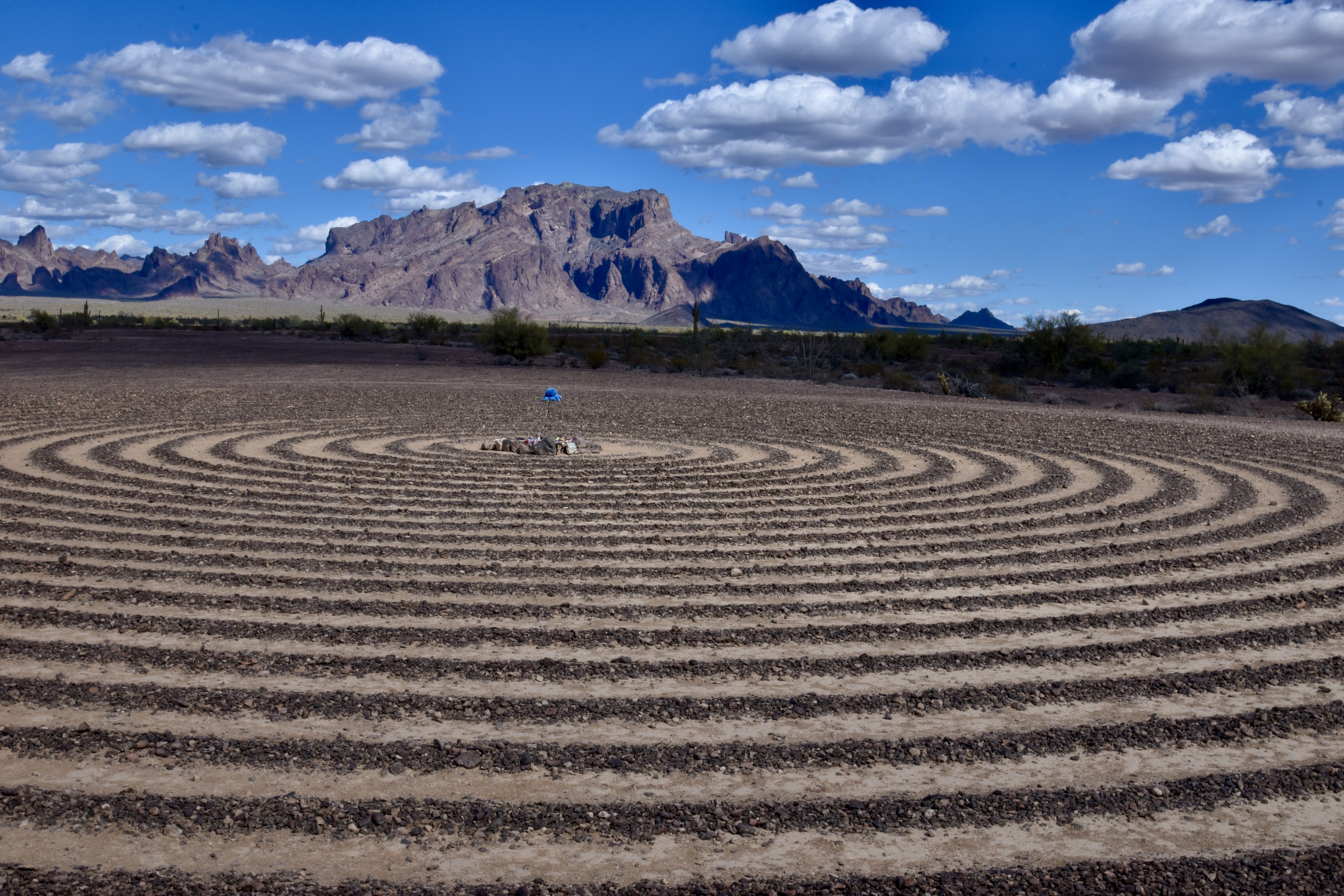
I found a great satisfaction as I walked: a strong sense of being only in the moment, no thought of the beginning nor of the end.  I had only experienced Chartres labyrinths previously; this was unique in that there were no twists and turns, only continuing forward.

The seƱor, however, had at some point counted the number of revolutions - 22.

Desert flowers . . .

Besides brittle bush, which was profusely blooming, we saw no other desert wildflowers, which made the ocotillo and palo verde flowers even more welcome.


Wednesday, March 30, 2022

A transformation, a resort, a rookery

A sign that pointed the way to West Wetlands Park got our attention, and our time there revealed what amazing things can be accomplished when humanity sets its collective mind to it.  The 110-acre site was not so long ago a city landfill, unused by 1970.  For starters, I had to wonder why a landfill was ever sited on the shore of a river, but that's another topic.

As we walked a good portion of the park, I could scarcely believe that what I was encountering had been a wasteland of invasive plant species and discarded junk until the transformation was begun in 1990.  In a mere 30 years, the ill-treated riverfront acreage has become a welcoming multi-use area.  Extensive riparian areas along the now-placid Colorado are alive with bird calls.  Multiple trails wind under tall tree canopies and through healthy underbrush, finding their way past ponds that give every appearance of having been nature-created, alive with the bass rumblings of bullfrogs.

Appealing to multiple interests, families and individuals have access to playing fields, picnic ramadas, fishing ponds and much more.  I am incredulous about what has been accomplished there.


Among the many birds we saw and heard there were some new ones for the trip list: kestrel, western kingbird, northern flicker, curve-billed thrasher, Anna's hummingbird, white-crowned sparrow and white-winged dove.

Crops and water treatment . . .

By the time the Colorado River reaches that southern locale, an astounding 90% of its water has been diverted to agriculture along the way.  At the Mexican border, we saw desalination facilities that treat the depleted flow before it enters Mexico.

 Vegetables of every ilk are grown in that clement region, as well as huge amounts of dates.  We saw some citrus orchards, but the climate seems much more suited to dates: the groves stretch for many miles.


One of our driving wanders along a waterway (they're everywhere!) surprised us with a small great blue heron rookery.  Even more surprising was that we had not spotted so much as one heron prior to that.  The large dead-and-falling-apart cottonwood tree supported four active nests, each with an adult heron and babies.


We also drove along Arizona's border with Mexico where we saw a number of birds (and one turtle) to add to the trip list.  Oddly enough, quite a few of them were lounging or swimming in a concrete-lined ditch instead of numerous more natural waterways.  We identified black-necked stilts, long-billed curlew, osprey, mallard and greater yellow-legs.

And then there was the fishing - take for the day - Chris: one fish, Rita: five mosquito bites.

Birds we identified on that jaunt at and around Mittry Lake included starling, canvasback, lesser goldfinch, roadrunner, white-faced ibis and kildeer.


Resortin' it . . .

Here we are at the corner of Jean Harlow and Spencer Tracy - neither were my favorite actors, but this Sun Vista resort where we've landed is not hard to take.  


We have been welcomed cordially by neighbors on every side, invited out to dinner, joined for Chris concerts, and just generally been taken into the fold, despite landing here at the end of the season and after friendships have been forged, many even over years of returning.  

True to desert weather, in just a few days, we have been sun scalded by temps in the high 90s, blasted by dust-laden wind and chilled to shivering in evening breezes.  Taking it in stride (we must; otherwise, we'd be sitting inside the Wolf Pup, a trailer the size of a walk-in closet), we don and remove flannels and sweaters, wear sandals or boots, shorts or jeans, and adapt.

The pool's water is so welcoming when the sun is scorching and the jacuzzi warms us when the cold wind blows (Johnny Rivers mentioned that in an entirely different way), but mostly we just go on our way with whatever plans have been made. . .


. . . and fruit smoothies help immensely.


I love this sentiment . . .


Saturday, March 26, 2022

Broccoli, birds, bighorns, behind bars 

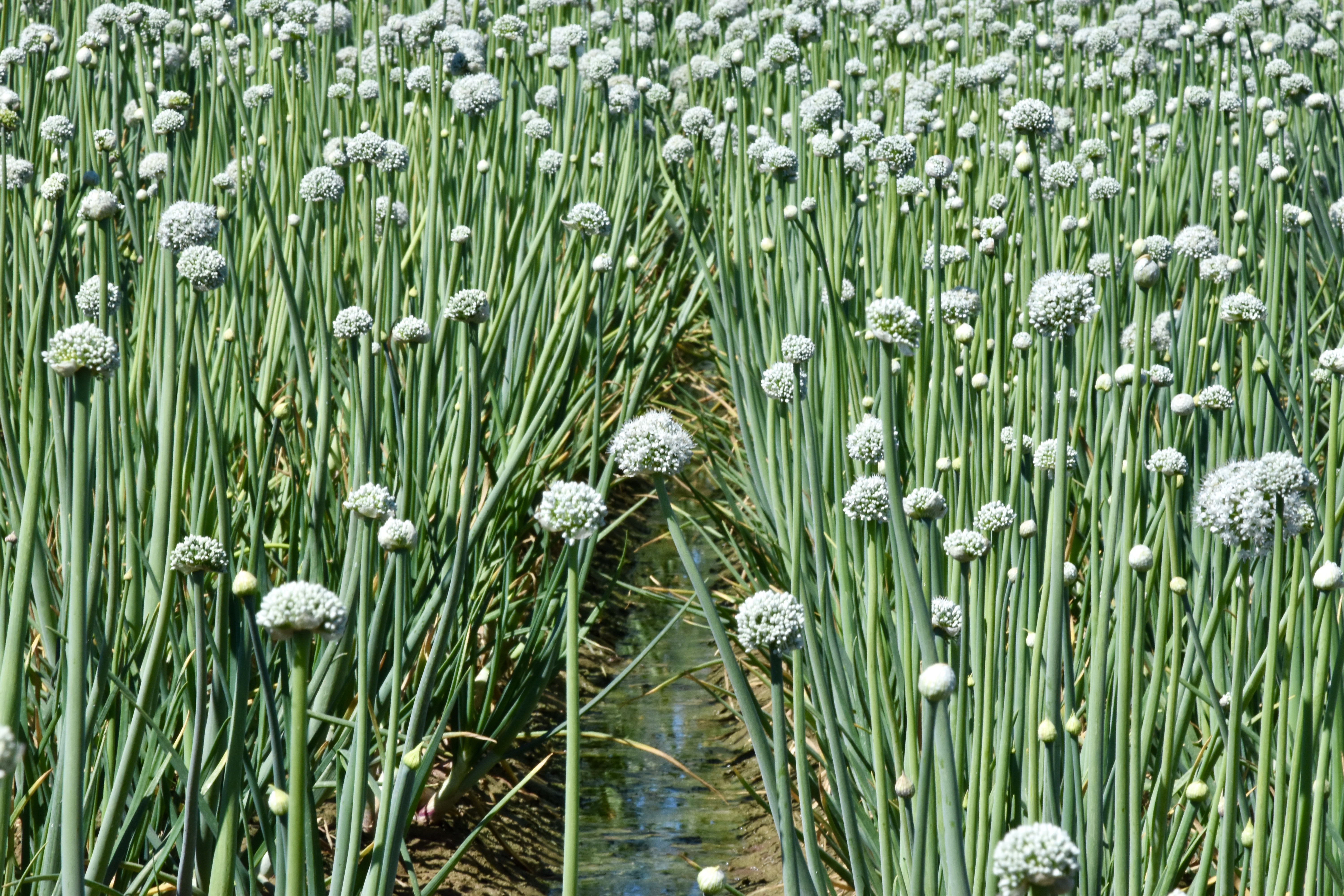
Agriculture is king in these parts.  Water from the Colorado, which is sadly diminished by the time it flows through here, is the lifeblood of crop cultivation, although it appears that some is irrigated with well water.  I've seen both sprinkler irrigation and ditch/furrow watering; thus I'm now an expert on all things agricultural here . . . well, maybe not all things.

I'm always interested in how various crops are harvested, so it was timely that we got to watch broccoli being taken directly from the field and tucked safely into boxes ready for the supermarket.  We watched the process shown in the photos below.  It works like this: a horizontal line of pickers is mostly under a shade roof cutting heads and passing them up to others on a platform in front of them.  There, the broccoli is trimmed and packed into boxes, which are placed on a conveyor belt that takes them to an attached truck where they are stacked for transport.  The picking/packing station is transported slowly forward by a tractor.  I expect the mechanism can clear a field very efficiently.


The cauliflower, though, is another matter.  We saw several fields that looked similar to what's pictured below: sections looked as if the leaves were wilted down and/or tractors had been through with the heads exposed, while other parts were mostly upright leaves.  In all cases, the cauliflower was unblanched and unharvested.  I hope to discover the answer to this mystery.


Wetlands . . .

All that water flowing through the river and its many channels and oxbows, not to mention manmade ditches and canals, provides magical riparian oases in the otherwise dry dusty flatlands.  We quite enjoyed wandering along with binoculars in hand, sighting waterfowl and dryland species at every juncture.  It's amazing how they find their niche in the grand scheme of things.

The bird list for the trip expanded quickly as we drove and walked different environments, and some of course right in the RV park, such as Gila woodpecker along with the ubiquitous house finch, mourning dove, Eurasian collared dove, great-tailed grackle, northern mockingbird, raven and house sparrow.

On and around the water, we saw red-winged blackbird, American coot, double-crested cormorant, neotropic cormorant, ring-necked duck, ruddy duck, great egret, snowy egret, Clark's grebe, pied-billed grebe, western grebe, Cooper's hawk, red-tailed hawk, belted kingfisher, common merganser, northern harrier, northern shoveler, white pelican, black Phoebe, Gambel's quail, lesser scaup, cliff swallow, violet-green swallow, cinnamon teal, Wilson's warbler and yellow-rumped warbler.

Curiously, when we stopped to identify distant pelicans, we saw two people on a tiny island about six feet across with absolutely no sign of how they came to be there.  They were wearing street clothes and had no boat or other conveyance.  They were too far away to hail, so we left them to their fate and me with my curiosity piqued. 

At the trailer, we put up a hummingbird feeder and saw both Costa's and black-chinned.  One amusing avian interaction occurred after a house finch repeatedly visited the feeder but was stymied because it contained no seeds.  On one still-hopeful visit, he was joined by a hummer that was feeding.  Aha - the light bulb went on when he saw how it was done!  Alas, although he imitated the hummingbird's feeding method, still no seeds were present and he flew away.  I'm fairly certain I saw a quizzical look on his countenance.

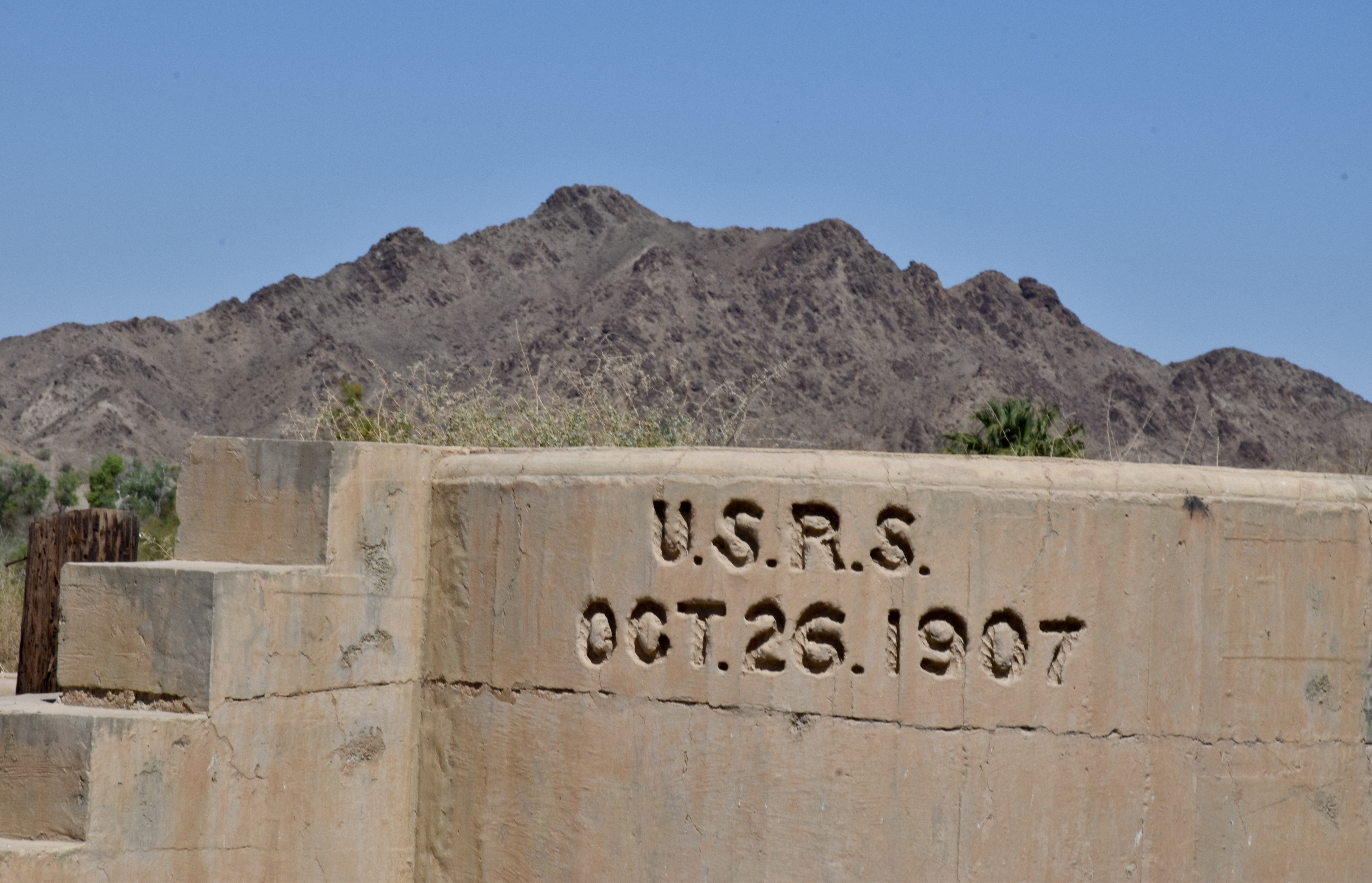
A venerable headgate structure still stands, although unused, over a vegetation-choked canal.  I'm guessing the U.S.R.S. initials inscribed into the cement way back in 1907 stand for the United States Reclamation Service.


The many man-made waterways transporting valuable water from the river criss-cross the land like the one shown below; however, the one that moves water for irrigation to the Imperial Valley carries far more than remains in the river itself on its way to the Sea of Cortez.


Mittry Lake, Martinez Lake, bighorn sheep . . .

We stopped for some angling and birdwatching at Mittry Lake, created by Laguna Dam, one of several along the river's course.  The water spreads out to fill winding bottoms and flatlands, accommodating wading birds, waterfowl and wildlife.  Our explorations also took us to the Martinez Lake/Imperial Dam area.


Birding was far more satisfying than fishing on that hot afternoon.  At one point, we were startled by a loud noise; "What was that?" we exclaimed simultaneously.  As I decided it must have been a bird call, I began to peruse the reed-lined shores when I spotted a common gallinule gliding briefly into open water and just as quickly disappearing back into the thick stands of stems.  We would never have known it was there except for that one call.  We had heard its raspy squawk before but didn't recognize it; I think next time, I will know it.

The park we chose somewhat randomly, Sun Vista, has turned out to be delightful: exceedingly friendly folks all around, sparkling clean huge pools indoors and out, super jacuzzi and activities enough to entertain and occupy the most demanding "camper".  There are sports, games, music; the list is endless, perfect for most who come here for the season from cold climes.  For our limited time in residence, we are more interested in the region's attraction, but we enjoyed live music and the pools immensely.

Despite all that, we stopped in to check out another RV park along the way, one centered around golf.  We were astounded to find that bighorn sheep are as attracted to the course as are the golfers.  There were two distinctly separate herds defined by gender - females with babies, and males - all grazing placidly on the grass, completely unperturbed by our presence.  I'm unsure if they allow the golfers to play through.


Yuma Territorial prison . . .

In the days prior to Arizona's statehood, those who ran afoul of the law were housed at a location dreaded more for its heat than the incarceration itself.  Abandoned for its stated purposed in 1909, the site is now maintained as a State park.

Although it is interesting to tour, I came away with an overall feeling of unease.  We learned about some of the individuals who spent time there, even women, and read and viewed some of the conditions: six prisoners to a very small cell in three-tiered bunks with scarcely room to turn around in 100+ degree summers - inhumane certainly and unimaginable.


And then there was the "dark cell" carved out of the rock cliff by inmates, where alleged incorrigibles were punished with not even a bed or bedding.


The guardhouse overlooks the compound and is constructed over the water tank.


On a much lighter note, the many aircraft that fly over from the nearby military base were joined by an intrepid individual put-putting overhead insanely (in my humble opinion) seated in a lawn chair suspended from a skimpy parachute contraption and propelled by a lawnmower motor.  Question: how many times has your lawnmower motor sputtered to a stop while you are manicuring the back yard?  Question: How much do you trust your life to those fouled spark plugs?


Wednesday, March 23, 2022

Timing is everything

It’s all about the timing.  In our case, we seem to have it down pat: wherever we venture, extreme weather is sure to occur.  The most recent instance of that was our January journey to Texas, intended to allow warmth-basking, but that was in reality a cold wet windy ordeal.  Now into March, we decided to explore the countryside around Yuma, situated to the south nicely on the Colorado River.  It seemed like a logical plan; however, the nearly 100-degree temperatures forecast during our week there took a little wind out of my sails.

Not to be deterred, we are well on our way as I type, hieing ourselves past the $4.99 gasoline at Congress Junction and hurtling down the two-lane road (hmm. . . the seƱor is driving, so “hurtling” does not portray the actuality, but we are moving along at a steady pace anyway).  

The desert is about as sere as I’ve ever seen it - saguaros back up on the infamous Yarnell Hill with scattered brittle bushes beginning their yellow blossoming - creosote bushes out here on the flats, and no grass cover on the hardpack earth, with a random bedraggled palm tree or two.

And then the magic of irrigation: lush green hay fields and row-cropped squares perfectly scored by furrows.

Memories upon memories scramble through my mind as we traverse this region for the umpteenth time.  There’s that familiar cotton gin, well-tended nut groves, long-abandoned structures that served multiple purposes through the years for these scattered farming settlements, clusters of snowbird RV enclaves, laser-leveled acreages being ceded to nature as water is withheld, a one-room stone building now roofless with gaping openings where window glass once kept wind at bay, an out-of-place VFW bingo hall, turkey vultures tipping back and forth in their characteristic way as they scour the land below, a foot traveler with backpack but oddly carrying a white plastic bag, crossing wide dry Centennial Wash where a flood ripped through years past due to tamarisk obstruction and drownings occurred inexplicably.

Bird migrations are in full swing; I filled the back yard feeders but expect that ten days hence when I return, they will be swinging in the breeze emptied.  I saw my first turkey vulture in Prescott yesterday, so they have returned there also for the season.  It will be interesting  to see what avian life is braving the heat down south.  Mourning dove and house finch are the unexciting additions to the bird list for this sojourn.