Wednesday, June 23, 2021

The other Las Vegas

Our few days in Las Vegas, New Mexico, were interesting in some ways and disappointing in others, although I'm fairly certain that any disappointment on my part has to do with grief for my boy, Darren.  It's been a month now since he was taken from us; thinking about it keeps me awake at night and is with me constantly throughout the day: wishing I could share with him what we are doing, remembering the feel of his wonderful strong calloused hands reaching out to help me up a steep slope, sharing a laugh over one thing or another, reliving our final interrupted conversation, going over and over his last days and wondering what he was thinking and was he afraid.  I feel an urgency to recall every memory of Darren's life as if somehow that will validate his existence.

We are heading home a day earlier than planned: I just need to be there, especially now that he has been cremated and the cremains are being sent to us.

What an awful start to a blog post, but that's where I am right now.  We did do some exploring in the region and found some to interest us.  Las Vegas is obviously a very economically depressed place.  I wonder if the New Mexico Highlands University, which was founded in 1898, and Luna Community College, plus the nearby United World College are a good part of what keeps it going.  Of course it's the county seat, so that helps.

There's also the historical aspect and access to the southern Rockies.  By the way, we saw quite a bit of snow in the Sangre de Cristos.  The town sits on a high plain at nearly 6,500 feet.  We saw many commercial and residential structures that dated from the 1800s that were beautiful architecture, but were in advanced stages of deterioration - a sad sight.

Despite the continual decline in population, there are some attempts to reverse the downturn.  The impressive centerpiece of downtown, the historic Plaza Hotel, is on its way to a lovely addition of outdoor restaurant seating across from the central plaza.  There is restoration underway for the historic Harvey House, Hotel Castañeda.

And the movie industry has utiliized Las Vegas for many films and television productions.  We could not resist taking our selfie in front of the door to Sheriff Walt Longmire's office.  Although no longer in production, the fictitious Absaroca Sheriff's office door has been left to attract fans such as us. 

In general, I thought the town was fairly seedy and down at the heels.  Still, history fascinates me and seeing the building pictured here was no exception.  It was built in 1836, and is notable because it was from its roof that Nuevo Mexico was claimed and proclaimed by the United States in 1846.

The verbiage of the actual proclamation by occupying General Phil Kearney is displayed on a plaque just opposite on the plaza.  We were a little shocked at its content, which basically stated that it was now U.S. territory and that all who were compliant would be protected from various native tribes but those who did not accept occupation would be hanged.


The countryside . . .

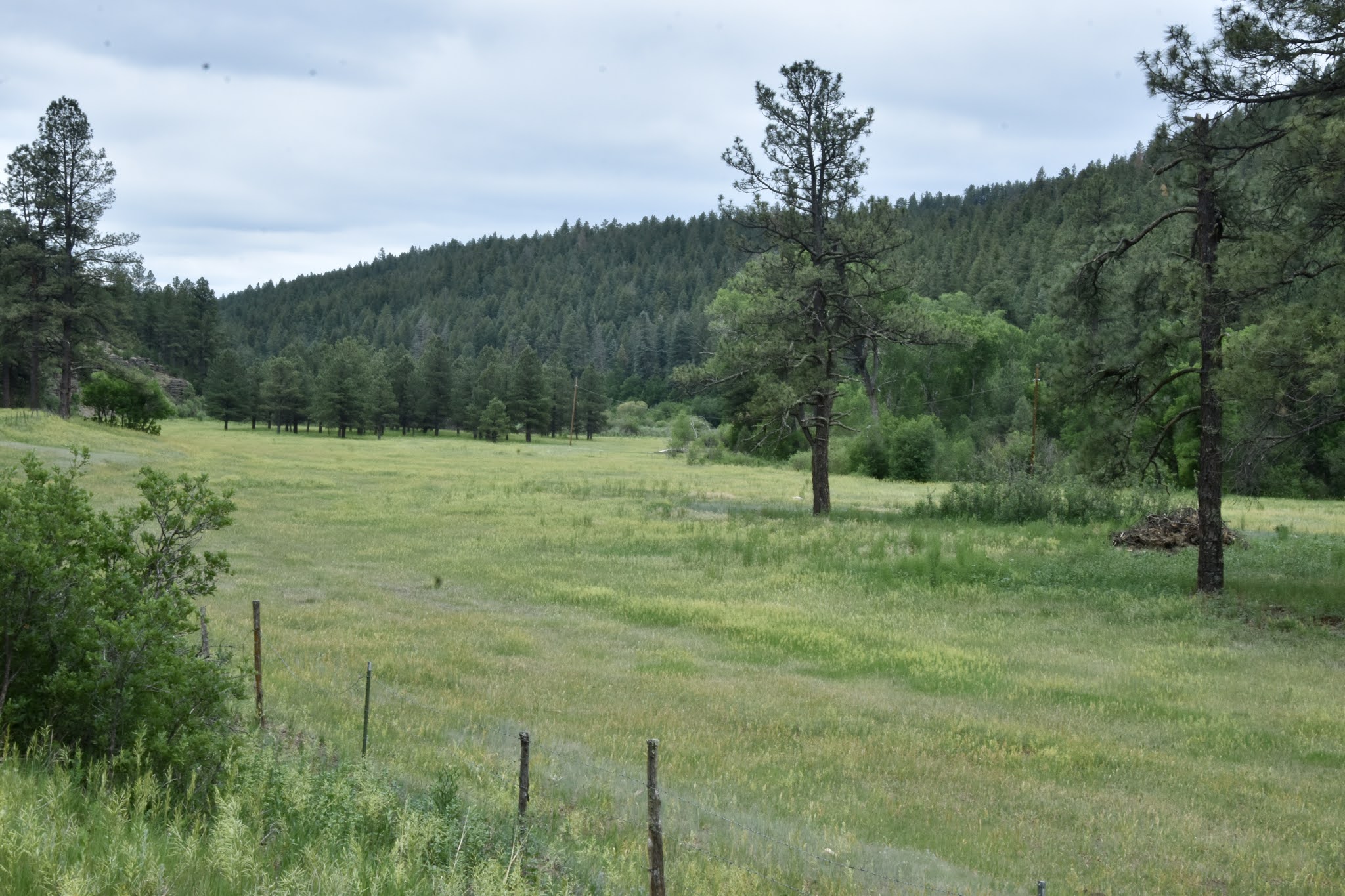
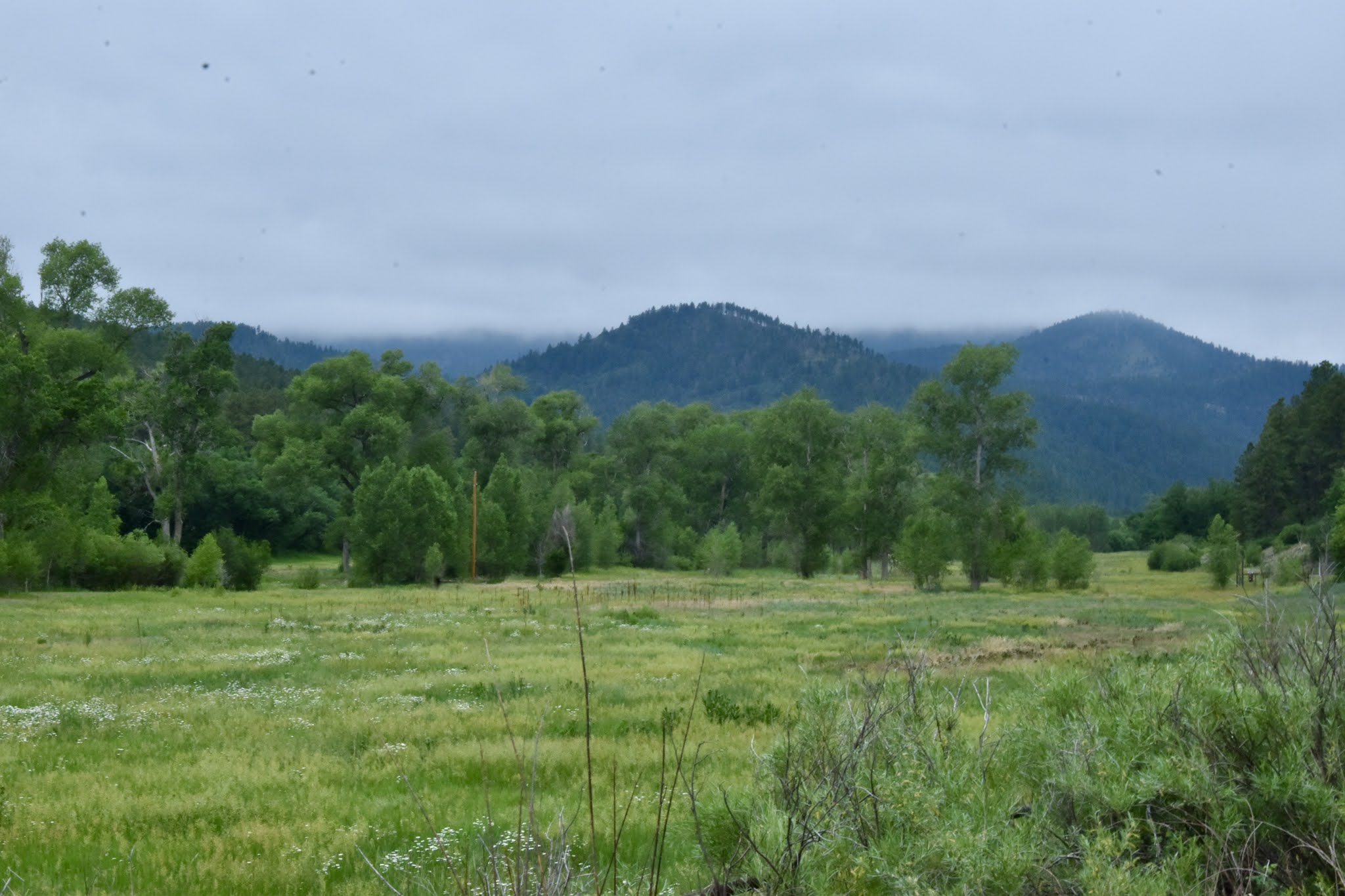
At one point or another, we drove out different directions to explore the region around town.  One jaunt took us along the Gallinas River.  

We would have expected to spy lots of wildlife through there, but a chicken drinking out of a puddle in the road was a bit surprising.

As we gained elevation fairly quickly, we came into thick ponderosa forest and the ubiquitous tiny New Mexican adobe settlements.

In Montezuma, we were astounded to come upon a magnificent Queen Anne structure peeking over the treetops.  It is now the campus of the Armand Hammer United World College, but was built in 1886 by the AT&SF Railroad as a luxury hotel at the site of natural hot springs.  We would have liked to explore the campus and the main building but were told that all was currently closed to tours, including the hot springs.

This was an odd remnant of a power plant from yesteryear.

As we ventured upward on a very narrow and winding road, we followed the Gallinas into its narrow canyon -  a place of great beauty, all posted private property, unfortunately.  By stopping in the road because there were almost no places wide enough to pull off, we shot a few photos and were especially intrigued by two small beaver dams.


Playas abound . . .

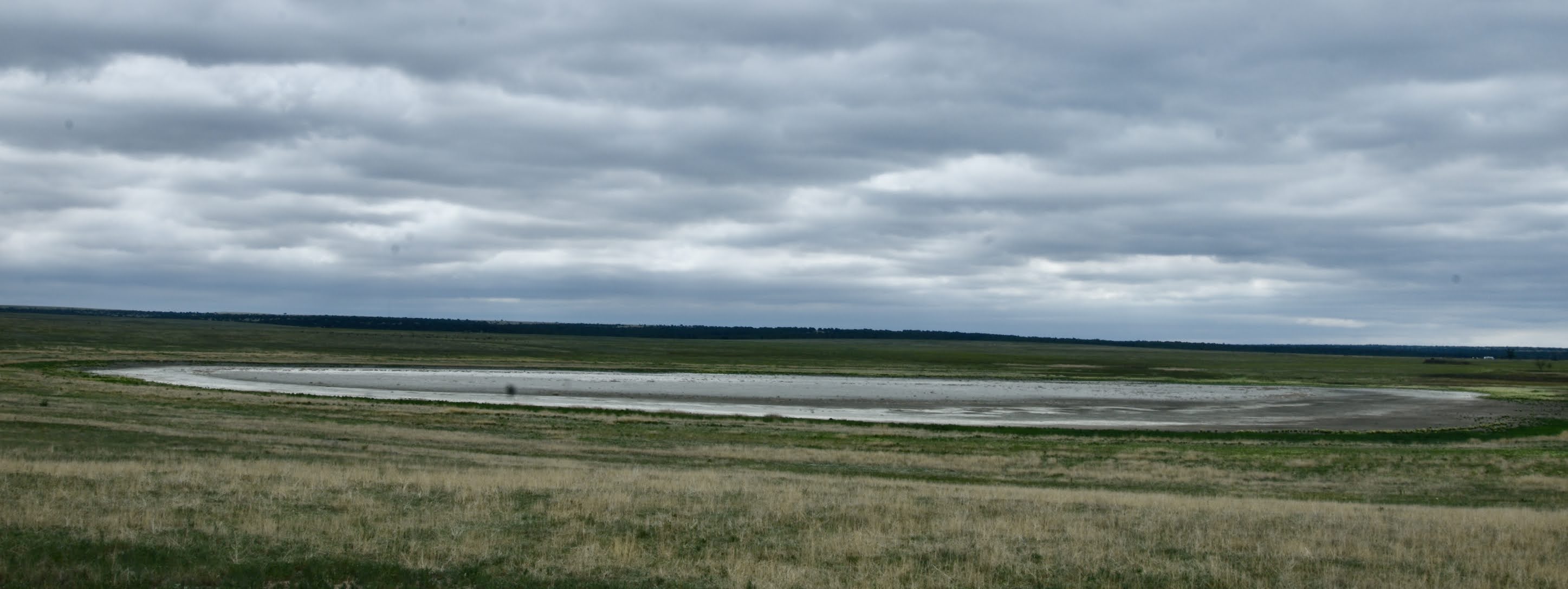
In that category I mentioned earlier of wildlife management areas that are duds, we found another one.  To tell the truth, this one may be awesome in the right season and conditions, but our visit did not fit that criteria.

There are many playas in this area: ephemeral lakes gone to dust without sufficient rainfall to fill them.  Without water, of course, the birds are elsewhere and game is scarce.  A fancy dancy visitor's center was locked up tight without so much as a notice of when or even if someone might deign to return to welcome visitors.

We did get some nice walking in, though, so there's that.


We were dressed for warm weather but low morning temps and a whipping wind insured that we were not overheated.
At least someone was interested in out passage . . .


We managed to consistently forget to note the birds we've added to the trip list; I will clump them all together here and hope I didn't leave any out.  New ones on this last leg of the trip include mountain bluebird, northern flicker, American goldfinch, black-headed grosbeak, red-tailed hawk, dark-eyed junco, horned lark, black-billed magpie, western meadowlark, northern harrier, Say's phoebe, red-naped sapsucker, lark sparrow, song sparrow, barn swallow and starling.

Monday, June 21, 2021

Drier climes

A kamikazee run with our noses pointed westward landed us in arid lands where water is a rare and precious commodity, where skies are the crystal blue unseen where humidity dims its clarity, where daytime temperatures cede sovereignty to sweater weather after sundown.

We pass right on through Oklahoma to our destination state, New Mexico, our Arizona neighbor to the east.  Lands level in every direction begin to be backdropped by mountains made blue by distance.

We begin climbing in elevation and come upon a reservoir, Conchas Lake, created by a huge dam on the Canadian River.  Our route is right along the single lane pavement atop that massive structure to see what is to be seen.  Sadly, the once large lake is so greatly diminished that I guess it's down 40 or 50 feet from full pool; as we know, that is a familiar story.


Remembering our son New Mexico style . . .

As a relatively steep road wound upward in front of us, we pulled out onto a side road to discern what we were spying through the thorny brush.  As suspected, it was a shrine, or should I say several of them.  On a boulder above the site we saw painted in white: "Virgin Mary Shrine".

One main structure was large enough to walk inside; all of them were well constructed and protected by glass doors.


While not of the Roman Catholic persuasion, we were grateful for the opportunity to write a blessing and leave an offering for our boy.  I find comfort in remembering Darren and honoring his joy in life even though it brings much sadness, anger and tears at the same time.

Just as we did, he would also have appreciated the many blooms on the prickly pears and staghorns near the shrine.


Longmire country . . .

A television series we've enjoyed - Longmire - was filmed partially in nearby Las Vegas, New Mexico.  Set in Wyoming, the producers found this country to be satisfactorily reminiscent of that region to produce it here.  We saw why when we topped out onto the high plains surrounded by vast mountains ranges: the similarity is strong  . . . and there's the historic downtown where the fictitious Absaroca County Sheriff's office still names Sheriff Longmire although the series has ended (perhaps more about that later).


Sunday, June 20, 2021

Threeish hours

As we depart from Shamrock, Texas, this morning, and head out across the mostly treeless plains, I'm pretty sure I can discern the curvature of the Earth way off yonder.  The contrast with the forests we left just yesterday is stark.  It's got me to thinking how different it is for us as we tear along at Interstate speed from what it was like not so very long ago for so many who experienced that change in their surroundings gradually as they lumbered along rough and rutted trails in their wagons for days on end, with little knowledge of what was to come.  Wouldn't you wonder if you had been misled or doubt the reports of what was ahead?

In that vein, we have an advantage about the countryside ahead of us, but so many times, we are reminded that the future is unknowable despite our illusions of what we think life will be like tomorrow.  The shock we experience when we are confronted with tragedy reminds us of our lack of control.  What is left then is only how we react.  Surely all of us have at one time or another surmised that we could not bear the loss of an offspring, yet millions have and do.  As with every experience of life, it is unknowable until you are there.

The fact of Darren's death seems unbearable, but we continue on for what purpose I am unsure.

So, this is what our morning's three hours on the Interstate highway has led me to.  Soon we will return to our preferred mode of travel on smaller slower side roads that allow for stopping whenever the mood dictates that something needs to be explored.

In this series of my blog, I have skipped over and/or completely ignored major parts of the journey.  Truthfully, my heart's not in it.  I will hearken back to one of the last places we visited with the kids: a wholly unexpected feature in Arkansas - a cypress swamp.  I am enamored of places such as that; we have explored a number of them with Darren in the past.

It was another preserve or wildlife management area that always stand out as a place to check out.  Sometimes they turn out to be duds - mostly closed off or lacking much interest - and this one seemed that it might be of that ilk.  We drove along dirt roads that flanked flat agricultural fields.  It became clear that many of them were planted in rice, obviously created as a refuge for migratory birds.

As we sought a route to the Black River that flows through there, we encountered sloughs supporting lacy-needled cypress trees with their root "knees" poking above the water where they prevent the tree from drowning in its watery lair.


One of us wandered out on a fallen log and opined that we could launch our kayaks from there when we return another time to fish and admire.  One of us opined that it would be a cold day in hell before we would try to launch a kayak from that log.

Between the silent swift river, surrounding park-like grassy areas, the sluggish sloughs, acres and acres of grain fields, I expect the place fair teems seasonally with millions of birds.

I was enchanted to come upon that spot so unexpectedly, and would love to return for more exploration and fishing.  Inexplicably, even there we encountered almost no mosquitoes; however, somewhere along the line we did pick up a few hitchhikers: ticks and possibly a few chiggers, or as I unfondly call them "chicks and tiggers".

We enjoyed an interesting wayside stop at a picturesque historic mill.  From near the structure, a 12-mile running battle occurred between Union and Confederate troops in 1864.  It jars the senses to realize the tragedy of war that marred the serenity we now experience in these places.  You can read a bit about the conflict at Martin Creek and Morgan's Mill here: https://www.hmdb.org/m.asp?m=49108.


Plentiful water lilies in this region and this was no exception

My sweeties and me . . .


 RVs anyone . . .