Saturday, November 27, 2021

Thanksgiving

As we are ensconced amidst a plethora of recreational vehicles on the shore of the Colorado River, I find myself resistant to writing.  In itself, that is a most unusual circumstance; typically, putting fingers to keyboard is balm to whatever is urging me on, whether it be elation or angst.

The reticence to write was a result of rational thought at war with emotion.  Being unable to make a decision between relating our experiences or sharing how I was feeling left me doing neither.

As always, that first step made the difference - I determined that telling one thing did not preclude the other; therefore, I began as usual with not the slightest idea what direction I was headed.

Ehrenberg, the Colorado, bees . . .

We had been to this region before and in fact at the same RV park, so it was an easy decision for an escape on Thanksgiving.  Of course we cannot escape our grief over our son’s death, but we can utilize a change of scenery to mitigate the intensity, and that is what we are doing.

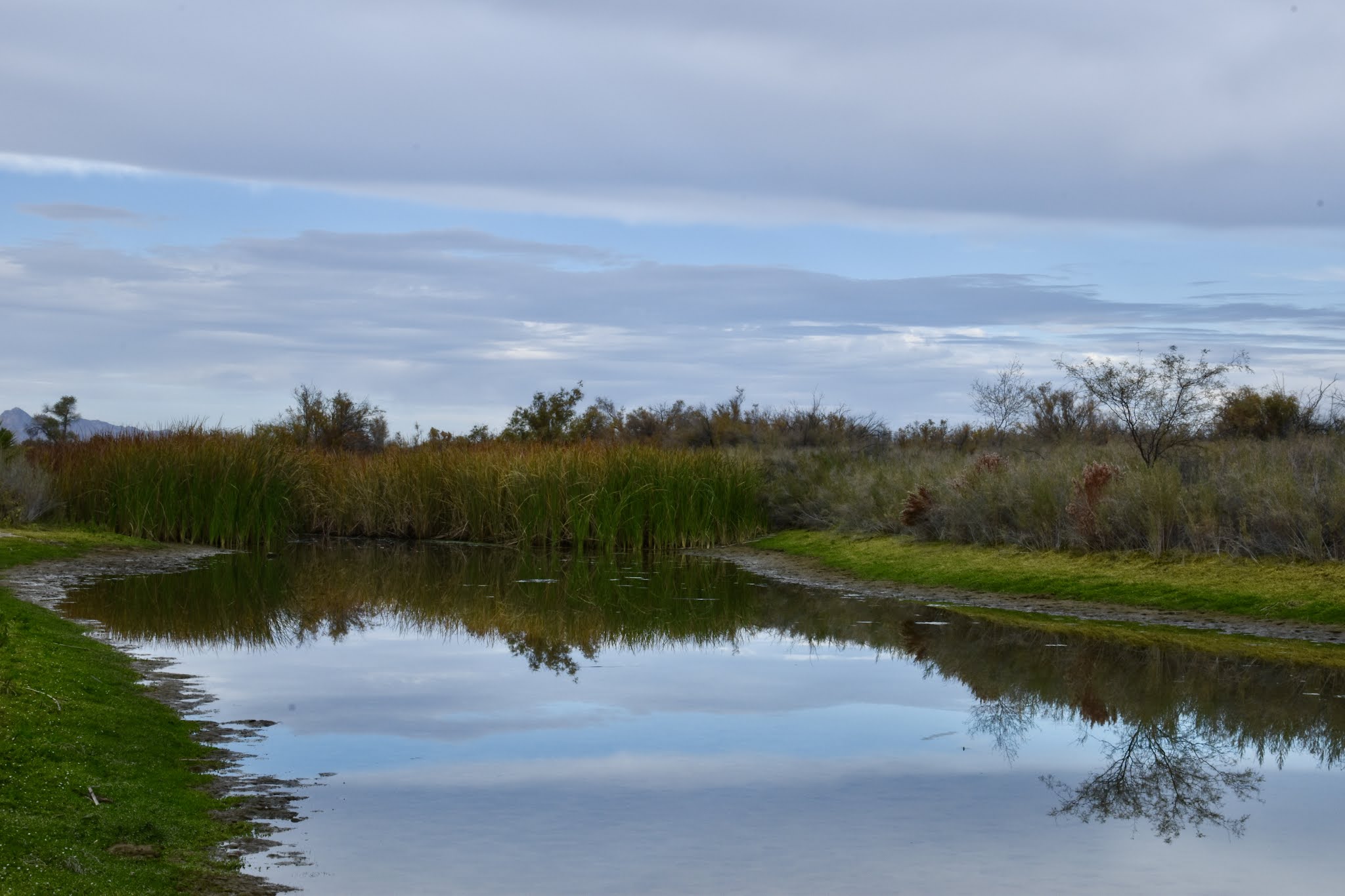
Being careful to remain on the Arizona side of the river, we tried out a few fishing spots and were rewarded by catching a few largemouth bass.  It seems that there is more river access across the way (a grass is greener conjuring?), but our Arizona fishing licenses carry no authority there.

I find that my enthusiasm for everything has waned, yet we managed to do some interesting explorations along the Oxbow and Levee roads, quasi parallel dusty gravel routes following the river’s course.

The levee road grew tedious after a time with its monotony: a steep-sided slide down to the brush-choked water’s edge, but with little actual access.  The lower Colorado appears placid in comparison to its canyon-churned white-water rapids further north, although its impressive width stealthily harbors a current I wouldn’t want to be caught in.

In a very few places, there are gaps in the levee where sandbars have created beaches and wide shallow sections of the river.  Nice for camping perhaps, but fishing not so much.

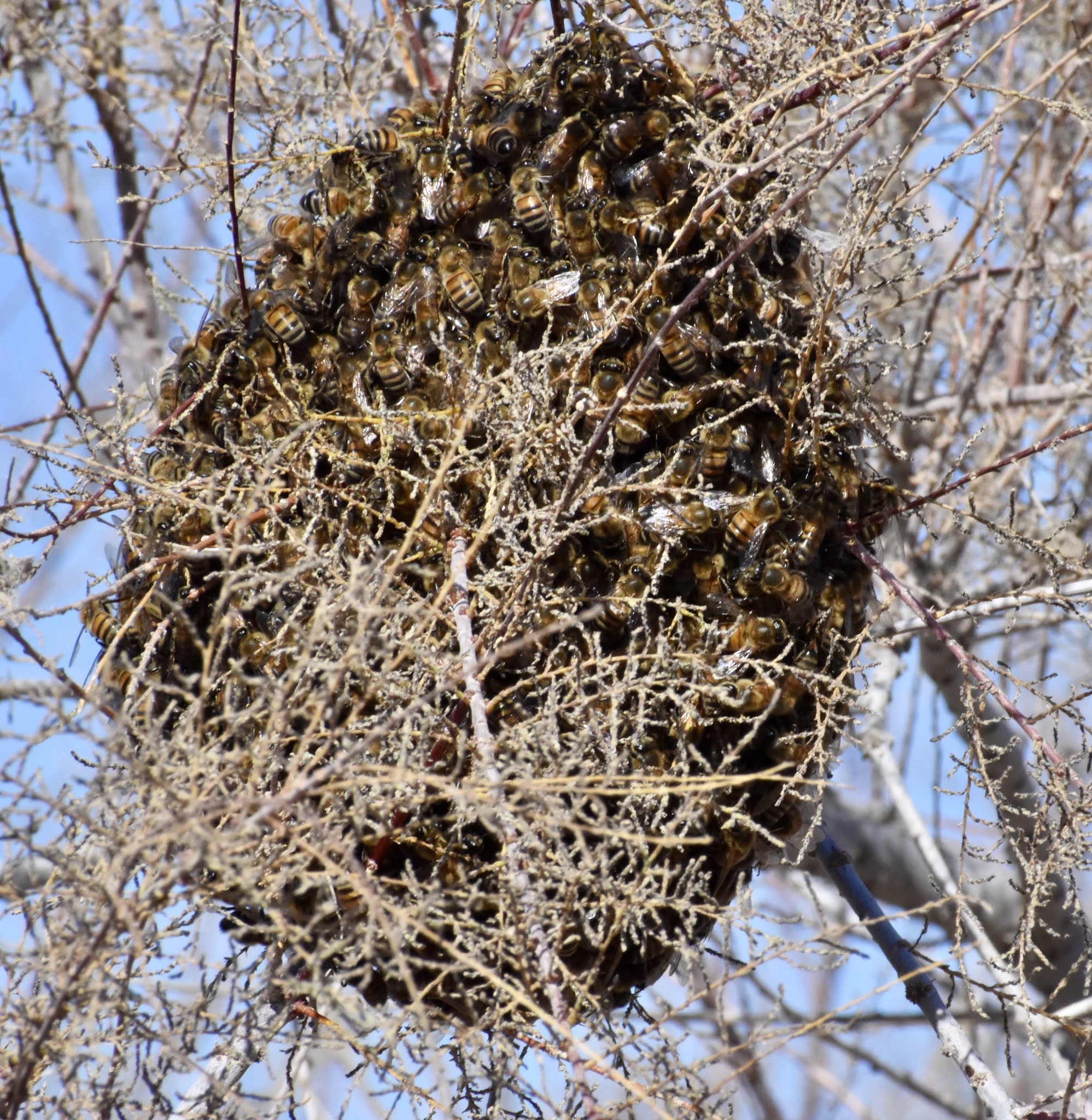
A bizarre sight on a random roadside scrubby tamarisk caused me to call out for a back-up to discover what I had just spotted.  Even at closer-than-completely comfortable range, the best I could discern was that the ovoid mass hanging on a branch was composed of a solid pack of bees.  I presume that it was a swarm on its way to creating a new hive, but I had never seen one that small nor that perfectly shaped.  The throng was about a foot high.  Most of the insects were solidly packed in like sardines on top of more sardines with nearly no movement visible, and a few individuals were flying around outside the swarm.

I enjoyed the views far more when we found our way onto the Oxbow Road that wound serpentine-like to follow back channels that have been cut off from the river.  Even there, the thickets often obscured views of the water and sometimes completely choked the channel.

In most places where a clearing allowed, there were people dry camping or homeless encampments set up.  I was intrigued by every glimpse of the waterway, and happier still when we discovered a mostly unused cove to settle in for some fishing.

But first of course, I had to go on an explore.  Meaning only to "just check over here", I found myself a goodly distance away wandering one way and then another, hiking and backtracking to find stream accesses as I admired the beauty of the place.  My meanderings took me over parched sandy flats where desert vegetation required lots of route finding to get through.  Those occasional openings to the oxbow channel were rendered more precious because of their scarcity.

This photo shows the hopelessness of getting through except where nature has provided openings.


Eventually, I surrendered to the realization that I had done a walk-about without informing the señor what I was intending.  How could I have told him; I didn't know myself until I had been lured on for a substantial distance and time.  

When all was said and done, I was certain that it was a perfect place to return with the kayaks.  It is a wonderfully serene old river channel to explore by boat.


Cayuses, palms, Marias . . . 

We were startled to spot a tiny herd of wild horses lined up to observe our passing as if they had expected a parade and we were a disappointing substitute.  I wished I had something to feed them; they were in pretty poor condition.  The graze prospects thereabouts are skimpy and less than nutritious.

Could not resist a halt to curb curiosity at an acreage where huge palms were packed cheek by jowl, rising up from otherwise laser-leveled hay and cotton fields.
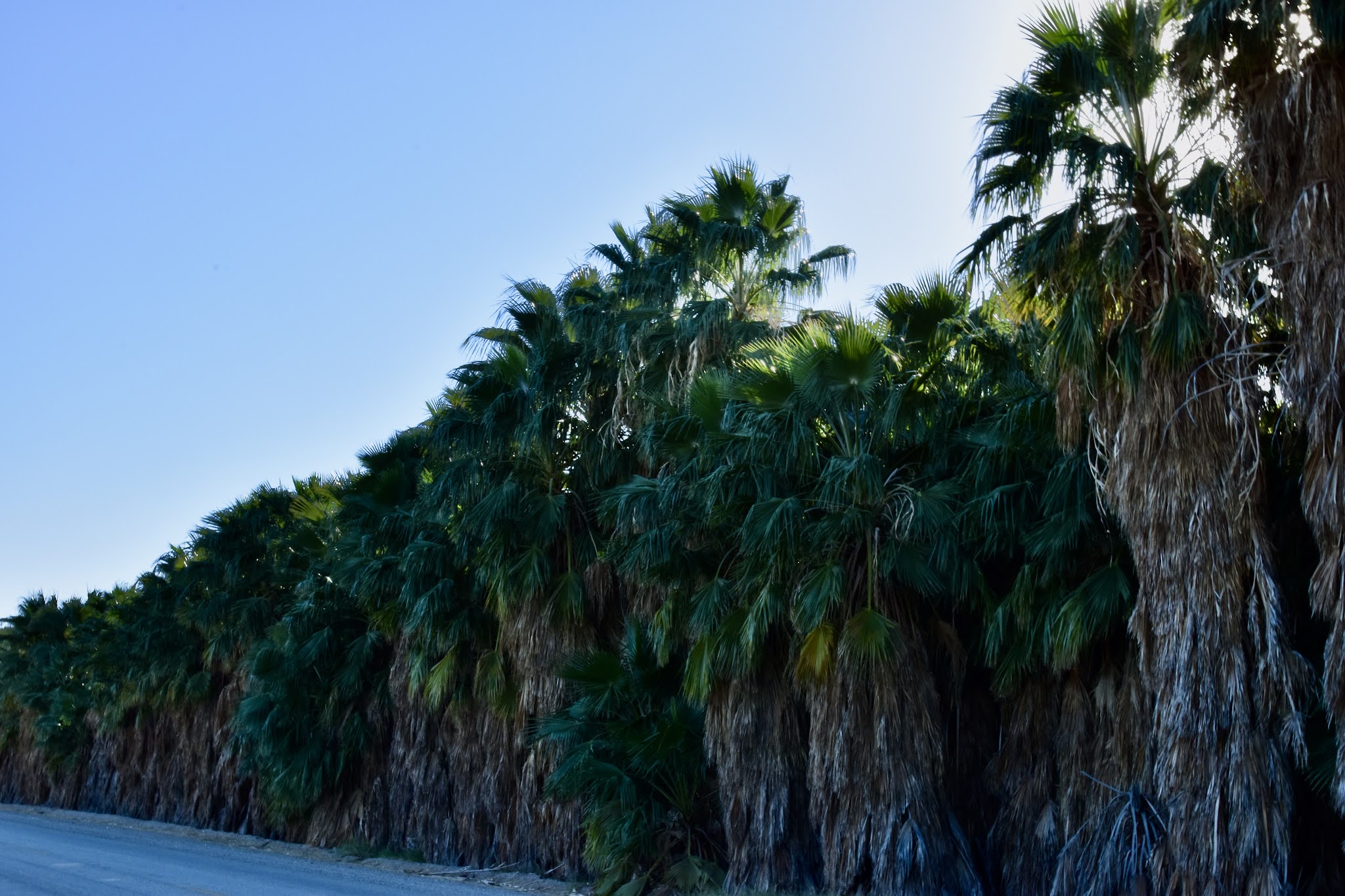
Our conclusion that it was a long abandoned date palm orchard did nothing to satisfy a wondering about why anyone would cease to care for the seeming cash cow that it must have been.  Do they age out?  I am clueless.


The Big Maria Mountains in California as seen from our vantage point one state east of there: they are a really beautiful wildly rugged appearing range.  I don't know where the Little Maria Mountains may be or even if there is a smaller counterpart.  My pard wondered if there was not both a big and small range, but whether they were named for Big Maria, whoever she may be.


Tuesday, October 26, 2021

A ranch and a river

Once again on a recent balmy morning, we jumped at the opportunity to revisit a stomping ground of old: Del Rio Ranch.  Through the efforts of the Chino Valley Historical Society - Kay Lauster, to be exact - we joined a group visiting that historic site.  With its once-artesian water and lush grasslands, that quarter of Chino Valley was prime for settlers, and hosted Arizona's first Territorial government prior to those officials moving onto Granite Creek to be closer to the burgeoning population of gold seekers in 1864.

After the departure of Territorial officials, a military contingent, and a newspaper publishing outfit, the place was homesteaded and farmed.

Quite a bit more personally, I wandered those grounds early in my Yavapai County tenure, and Chris resided in one of the several residences on the ranch.  

An adobe building that is said to have predated the Territorial and military personnel was damaged in a fire and the ruins bulldozed much later.  Both Chris & I remember being in that roofless structure and being surprised to see prehistoric pottery shards incorporated into the adobe mud walls.

In this photo, Kay is at the adobe's site and showing photos of the building in its heyday.  Oh yes, the señor is getting in his two cents worth.

The remaining structures are nearly all badly deteriorated.  Although the property is leased for running cattle, it is for sale and nothing is being done to preserve the buildings, unfortunately.  They all date from the days in the early 1900s when the Fred Harvey company maintained a thriving business there for supplying its Grand Canyon and other enterprises with water, produce, dairy products and meat via the railroad line that borders the ranch.


Several of our friends from younger years resided in others of the dwellings at Del Rio.  It's one thing to wander through abandoned houses, which we've done many times, but there's something very odd in doing the same in buildings that were a part of our life.  The boards and stones of structures derive their life from those within their walls; when they are left alone, they begin a slow decline to collapse as if deprived of breath and blood.

Dave & Sam lived in this big blue house and it was full of energy then.  How strange to enter there now and feel its lifelessness.


Some left their mark as they worked to build ditches to move precious water from one pasture to another.

As a group, we walked the two-track that leads to the small Del Rio burying ground, now severely overgrown with huge weeds fed by the summer's monsoons.

Where once there were markers placed to memorialize those they laid to rest there, now one grave only is visible, undoubtedly the other stones taken away by vandals.  I photographed that cemetery sometime about 1977, and in a fit of doing what's right, donated the prints to Sharlot Hall Museum.  Sad to say, that facility has failed in that bit of preservation; they seem not to be able to retrieve the photos.


It was a fine day to share memories and to wish that ranch, with its prehistoric and historic importance could be saved from becoming yet another high-dollar megalopolis green with golf courses instead of livestock pastures, paved smooth instead of rolling hills dotted with native vegetation, covered with huge high-dollar houses for retired couples instead of modest structures that speak of a life close to the land.


Before the river . . .

. . . I had the opportunity to meet with friends in Camp Verde for a rousing game of mah jong.  It just so happened that the señor & I had planned to relocate Wolfie in that vicinity on that particular day.  Perfect - he dropped me off for the game (but not before imparting certain words of wisdom and snapping our pic) . . .


 . . . and proceeded to take the trailer on to the RV park and set it up in the shade of a giant mesquite tree. . .

. . . a lovely spot at Thousand Trails.  Since we stopped there in a previous year, the park has changed in its character quite a bit.  A great many of the RVs there are now full-time residences, which does not to my way of thinking improve its stature as a prime RV park.  No matter, we did avail ourselves of the nice pool and spa when we weren't getting skunked at fishing.

To be sure, although the score was badly skewed toward the fish, they did not all get away, and this big boy is proof.

One does have to put some effort into getting to the Verde River before one can use that perennial stream for fishing, swimming, kayaking or any of the other pleasurable pursuits that are to be had in that riparian environment.

From our perch, a trail of sorts started off simply enough, for a few yards at least, until it dropped off  on what once was likely a nice dirt path, but which has eroded into nothing more than a steep downhill climb over loose river rock.  Not terrible, really, as long as one exercises caution, at least until we came to a dropoff that was sheer enough that some before us had installed ladders.  One look convinced us that climbing down the rock face was safer than trusting either of those two wooden ladders, so that's what we did.

Over millennia, the river has carved out a wide valley in places.  The view across reveals rocky cliffs on both sides towering over flats thick with mesquite, cat claw and other desert vegetation, mostly inhospitable, with the lushness of cottonwoods and willows at the water's edge.


River seekers of the human and animal variety have found ways through the thickets that we utilized by meandering whichever way looked most feasible, backtracking when necessary and winding around in serpentine ways.

Our scramble took us over dried mud flats . . .

  
. . . revealed fall flowers . . .

 
 . . . visited by flitting nectar feeders. . .


. . . and autumn-hued Virginia creeper . . .


. . . before finally bringing us to the vegetation-tangled banks of the Verde.  Somehow, it always seems to me that the Verde is made more special because of its relative inaccessibility.


During our short stay, I was less enthusiastic about exploring the environment than is my wont, so more time was spent in slightly more sedentary pursuits.  We read, played cards, ate, lazed around in the spa listening to oldies, read some more, ate some more, and chatted with neighbors.

We did rouse enough to find another route to the river, a far easier walk in a wide level sand wash, which brought us to the site of a rudimentary rock dam that diverts water for irrigation.

That obstruction has backed the river's flow up into a miles-long pool far different than the Verde's more often whitewater rush over rocks.  It also transforms that section into more of an environment for catfish and carp than smallmouth bass and trout.

Others who wanted to gain the river bank have hacked away in places at cattails and bamboo to open up bits of shoreline.

Most of the shoreline, though, remains a brushy marshy morass through there.


Though my energy was at a fairly low ebb, I enjoyed being at the Verde, as always, and appreciated the señor encouraging the outing.  Certainly grief at the loss of our Darren is affecting my attitude toward life, but knowing that he would want us to savor each moment we are given helps to keep me going.  
 
I remember the last time we hiked into the Verde canyon with Darren: his enthusiasm was palpable as he fair ran from one spot to another, and was over the moon when he jumped out a herd of bighorn sheep.  We are cut from the same cloth.