Sunday, August 24, 2025

 Never again . . .

 . . . will I pursue my not-so-bright idea to leave my good camera safe on the closet shelf at home.  Thinking ahead to what we might be doing while in San Diego, a bit of paranoia crept in.  I wouldn't want to take it onto the beach where the insidious sand gets into everything, and I wouldn't want to leave it in the truck parked at a beach lot; therefore, I left it at home, and brought my old one.

Turns out that one is next to unusable: the view screen is unviewable in the sun, and the zoom only kinda works and I have to hold it outward while trying to see the unviewable view screen, so the tremor is worse.  Basically, I end up with wild shots of sky and little of what I had hoped for.  That leads me to use the phone camera, which works fine; however, see previous sentence . . . and sans cable, I have to send every photo individually to my email, where I have to load each one into a photo program . . . well, anyway - never again.  The process was frustrating and limiting where I could have been getting wonderful pics.

We began one of our days without a plan (oh right, that's all of them), and had a nice long walk along the Mission Bay estuary, then over low dunes and onto a tide flat.

Doggie beach was nearby, so we were joined by lots of canines who brought their people.  This one was particularly notable in that he arrived without his fire engine.  His person showed off his tricks, which I attempted to photograph; however (see intro).

Dogs and their humans were outnumbered by terns (one good tern deserves another - couldn't help myself) - hundreds of them - Forster's, least & Caspian - making quite a showing for themselves.  Although they were the main show, we spotted others both there and at other places along the water. 

Some of the ones we identified included snowy & great egrets, California & herring gulls, double-crested cormorants, marbled godwits, great blue herons, little blue herons, killdeers, brown pelicans, spotted sandpipers, willetts, even a life bird for us: a whimbrel.

When we perused that waterway the next day, the tide was coming in to cover where we had walked.

The highlight . . .

. . . of our jaunt to the coast was to have time (but not enough) with our great niece & nephew - Bri & Chris.  If he wasn't such a stellar guy, we'd have to oust him from the family or else change his name.  We've gone from having so many Pats that each one had to have an identifier in front of his/her name (as in Dad's Pat, so now we're faced with "my" Chris, "Bri's" Chris, Christie, etc.

Bri's Chris is just dandy, though, so he passes muster.  We had fun with them, eating out at Old Town San Diego, followed up by a ghost tour.  That feller to my right in the photo is not a subject of the tour, nor is he identified.

The historic Cosmopolitan Hotel was the culmination of the tour.  Now restored nearer to its 1870s existence, it began nearly 200 years ago as an adobe home.  Other iterations included a restaurant/stagecoach office and an olive cannery.  Now functioning as a hotel and restaurant, it has its stories of hauntings.

We stopped at El Campo Santo, the original burying ground.  There I was shocked to learn that, although some graves were relocated in the past, many others were simply paved over when a railway was constructed through there.  The current sidewalk and roadway cover gravesites, as noted by markers in the pavement.


During another visit to Old Town, we just missed a street performance by several flamboyant dancers.  One of them, originally from Jalisco, told us a good bit about the group.  They design their own costumes, and enjoy performing publicly, while emphasizing good family and community standards.


 As seaports tend to predate inland communities . . .

. . . so does San Diego's history go way back.  One place we enjoyed seeing was the Casa de Estudillo, an interesting home for multiple generations of Estudillos dating to 1825, and as typical in early days, it served as a sort of community/commercial center.


With expansions over time, the large one-story edifice is horseshoe-shaped around a central plaza . . .

. . . with rooms elegantly furnished.


One very unusual feature is an impressively widespread vine said to be toxic even to the touch, despite its beauty.  I took the warning seriously.


 Fiesta in Old Town . . .


California's first mission . . .

. . . established by Franciscans Junipero Serra, Juan Viscaino & Fernando Perron in 1769 stands restored on the site to which it was moved in 1774.

Despite a long-ago uprising of native people that culminated in the death of a Spanish missionary, Mission San Diego de Alcala is now a place of peaceful tranquility and beauty.  We spent a good deal of time there on a self-guided tour that told many aspects of the outpost's history and especially about the life of Junipero Serra.

The friars' quarters . . .

We lit a candle for Darren, as we do whenever there is an opportunity.  It makes for a teary interlude.  Chris says he thinks Darren enjoys having us bring him along on our adventures, and I don't disagree.  He did love to adventure!


It was said that this handmade flag was found during excavations at the mission site, presumably following the tradition of a family member making one for a loved one leaving to serve in the military.


In the category . . .

. . . of "You never know what you might find", I happened to notice a bas relief plaque (It was one of those "Stop, back up!" situations) proclaiming the La Playa Trail.


One of us was excited to explore further; however, one of us (the señor, to be precise) declined my exhortations, and truthfully, I was likely too tired to insist.

Research indicates that the trail has been recognized as the oldest commercial trail in the western United States, having been utilized during the pre-Hispanic period, and that there are eight registered National Historic Districts and 70 identified historic sites along it.  It connects the settled inland area to the commercial anchorage at Old La Playa on Point Loma in San Diego Bay.

If I lived in the area, I would want to walk it; if I visit again, I will do at least part of it.

I am enthralled . . .

. . . by all the botanicals in the region, most of them native to there, but nearly all exotic in my eyes, and huge by any standards.  I guess that is what happens when the temperatures remain above freezing.  I was told this tree is a ficus, but I can tell you, I've never had a ficus like that!

If I said it once, I said it a hundred times while in San Diego: "Look at that tree!"


Saturday, August 23, 2025

We’re officially old . . .

. . . and this is how I know it.  Whilst we were playing in the surf, holding hands and being a bit pummeled by waves breaking, a woman approached us with concern.  She cautioned us about the uneven sea bed and offered to assist us.  After we assured her that we were alright, we just looked at each with the understanding that . . . sure enough . . . we must be old. 

Despite that, what a really lovely time we had at Mission Beach, even in our dotage!  The beach is as the beach is always, and that knowing has sustained me through many difficult times.  When I stop to think about the waves lapping at the sand, the breakers crashing, the never-ending rhythmic movement, and know that it is all a part of the timelessness, I am soothed.

Over that are the people scuttling around - our activities frenetic in comparison to the Earth's strength.

I watch as we all observe our parts in the dance.  One beachgoer took the dance analogy to heart: for a verrry long time, she clapped her hands to a tune heard only by her, moving her hands and and arms to the soundless tune, occasionally even rising for a spell of sand dancing.

And there was the bubble lady . . .


. . . the metal detector . . .


the gulls guilty but unabashed at stealing bags of chips from under a towel . . .


. . . the parasailors . . .


. . . there were tents, umbrellas, shade screens, and shelters of every kind imaginable . . .


. . . and even the nefarious vendor of snacks.  I didn't photograph her lest I become involved in some kind of illegal beach doin's, but there was an air of crime movie shenanigans about it.  The woman dragged a partially broken-wheeled wagon through the sand, evidently offering the sale of items within via a small cardboard sign.

Now this a true story: I watched as she paused to take a phone call, at which point, she quickly got behind a group of people, lowered her sign and covered it and the wagon's contents with a towel, and changed her appearance!  It was exactly like in the movies!  She removed her hat, shook loose her hair bun and took off her outer garment - voila - a different person!  No idea what it meant, but it was amazing to watch.  I didn't take her photo to protect the possible innocent.

Fishing, of course . . .

The señor, too frugal (ahem) to purchase California fishing licenses, discovered a few localities that offer "free" fishing.  I was a bit cautious, especially when the purveyor of bait had never heard of such; however, in the end, I went along, hoping that we wouldn't end up in the hoosegow with our truck confiscated.

The chosen spot involved climbing jumbles of gigantic boulders, up one side and down the other, in order to offer frozen shrimp to the denizens of that stretch of salt water.  No broken bones nor sprains ensued, I am pleased to report; unfortunately, there was a dearth of fish interest in what we had to offer, but that did not prevent me from whiling away the time by filming the tiny crab congregation just below my perch, and being mesmerized by the musical water currents as they danced the vegetation just at its level.


What . . .

. . . in tarnation is that crazed fella doing out there!?  We figured out later that he was propelling himself across the water on a hydrofoil kind of contraption.  Seems it required him to get the forward speed going by pumping the board and paddling like a mad fiend, at which point, the board lifted out of the water and away he went, except that it did not continue unless he kept at his labors, so I'm not sure what was the point.


Being tide pool aficionados . . .

. . . we took advantage of low tide to peruse the pools at Point Loma.  It's all very subtle, but once a person slows down and looks carefully, it's quite fascinating to find the anemones, limpets, crabs, and other denizens that patiently await the return of ocean water to cover them.


Cabrillo National Monument . . .

. . . high on Point Loma features a statue representing Juan Rodriguez Cabrillo, who was the first European to reach the west coast of what is now the United States.   That was in 1542.  His landing place is below that viewpoint, as it offers a vista toward San Diego's Coronado Island and the city beyond.


One of the features of Coronado is the home port of the U.S. Pacific Fleet, the largest Navy base on the West Coast.  This view from Point Loma is toward Coronado.


Crystal Pier . . .

. . . a unique lodging over the water was fun to check out, especially after friends had told us about staying there.  I don't know the history of how it came to be, but I'm intrigued with the concept: individual cabins lining both sides of the pier near its dryland connection.


As we pass the cabins, we see beach beyond and below.  On the further reaches are the usual pier fisherpeople hoping for a good catch.


I revel in the senses aroused near the ocean: water everywhere I look, the scent of salt air, perhaps most of all - the always-there roar of the surf.  

As a desert rat by birth, I prefer inland for my abode; but perhaps because of that, I am drawn to water, and most especially the ocean, thus achieving a sense of balance.  A way of being for those near the sea is completely unknown to me, and I love the sense of discovery when I venture there.


Thursday, August 21, 2025

Along the way

It has been such a vanishingly long time since we have heeded the call of the great Pacific Ocean’s shorelines along the southern California coast, yet here we are: approaching the border that separates Arizona from that state to our west, at long last anticipating being in the surf this afternoon.

No matter that we have overpacked, forget that the bedroom window is still wide open after being ajar to invite in the cool night air.  We have six days carved out between Tuesday night music gigs at Augie’s Restaurant and we intend to spend them in the San Diego vicinity, primarily up to our necks in salt water or lounging on the sand.

Am I crazy anxious to be there - yes, most emphatically!  Does that stop me from calling a halt at various sites to satisfy my curiosity about what I spy out the window of the truck speeding along the highway - no!  Admittedly, I do allow a few things to pass in the rear-view mirror; however, by 10 a.m., we had already turned around a couple of times for photo ops.

One acreage speckled with moldering melons and accented by weeds grown beyond maturity piqued our interest enough for a shot stop, as if somehow, we would find the answer by standing at the edge of the field.


Alas, we could not discern the why of it, but clearly a farmer had planted the large plot with watermelons, installed miles of plastic mulch and drip line.  Come harvest time, however, the melons remained where they grew atop deteriorating plastic.  

The good news is that we never have to stand in line to see the things that grab my attention; no one else gives a rip, and for good reason.  Even stopping to be amazed at the jagged skyline of the Kofa Mountains, causes no backup, as we recall the time we climbed up in there to fulfill my long-term yen to see the unique native palm grove tucked up into one of its canyons.


Further back up the road, we pulled over briefly for a photo op at the entrance road to the former Robson’s Mining World, just because the iconic sign is sure to complete its submission to the elements before too long.


At this advanced age, many things dredge up memories from past occurrences, and that is one of those.  It was like this: along about 1990 or so, Charles Robson contacted the señor with the request that he expand his Elderhostel program to Robson's facility.  

One thing led to another, as things are wont to do, with the result that for about a decade, Yavapai College offered week-long active educational programs for senior adults interested in hiking, history and the natural world.

Sadly, the lodge at Robson’s burned; Charles passed away, and the site was for a spell relegated to day trips by the señor’s Edventures programs until it wasn’t,  Subsequent visits have revealed frightful conditions resulting in extensive damage to Charles’ once impressive multiiple-room museum of old west artifacts.

Thus I pass the time while my pard drives the six-hours-if-we-didn’t-keep-stopping journey to the ocean.  Can I sense the smell of ocean spray yet?  Not really, after all, we have only just passed Yuma’s vast agricultural fields (now dormant in the summer heat, but soon to be lushly verdant with their mild winter crops), crossed over the border marked by the Colorado River, remarked at the mountainous sand dunes, and entered the flat flat Imperial Valley.

But soon . . . the Pacific!

In conversation, it becomes clear that it has been nigh on to 30 years since we have ventured into those parts.  I am incredulous at the thought, as I always am when I realize the extreme passage of time that I might have categorized as "just the other day" or something similar.

Before the beach . . .

. . . we check into our living quarters that will be home for five days.  Perfectly adequate, squeaky clean . . . and approximately the size of a postage stamp, albeit the airmail type.  For those under the age of 100, I refer to the olden days, when, in order to have our letter delivered to its destination via an airplane, as opposed to ground, we bought a special "air mail" stamp, wrote the words "air mail" on the envelope, lest the post office not notice the special slightly larger stamp.  Granted, our ground delivery was a step above pony express, but air mail was something special. (I admit that when I scribe memories such as this, I wonder if I actually recall this, or did I read it in a history book.)

And then . . .

. . . I tested the waters - warm enough for swimming rather than the icy cold I remember from earlier-in-the-summer visits . . .

. . . and the señor agrees.


Fairly rough surf at Mission Beach on our first venture into the water; a rip current was present shortly afterward, and lifeguards were calling for folks to get out.  It will be interesting to use the next few days for exploration.

Friday, July 18, 2025

The day I . . .

. . . locked the keys in the truck began serenely enough at our Holbrook, Arizona, motel with a nice breakfast and coffee.  One night away to visit our son, Lewis, in nearby Joseph City: the three of us were off to McHood Reservoir, a lovely little lake that winds through a canyon of solid rock.


Fishing gear at the ready, we were encouraged by the large trout feeding on the surface.  Our shadeless posts on stone perches quickly became uncomfortable; I decided I would change my clothing for better coverage, and it was all downhill from there.

I exchanged my wardrobe at the truck, dropped my discarded tank top onto the keys that were lying on the seat and, even with a hesitation about maybe leaving the truck unlocked because we were nearby, flicked the fateful switch, blithely unaware of my mistake until the señor requested his keys.  

Fool-proof way to put a damper on activities, but there was better news: we were not at the end of a 15-mile unnamed dirt track in the middle of nowhere.  A phone call later, and we were rescued by a fine gentleman from the not-very-far-away town, who encouraged me immensely with his cheery repeats: “No problem!”  Easy for him to say, we were replenishing his wallet by my momentary brain-dead maneuver.


Historical irrigating . . .

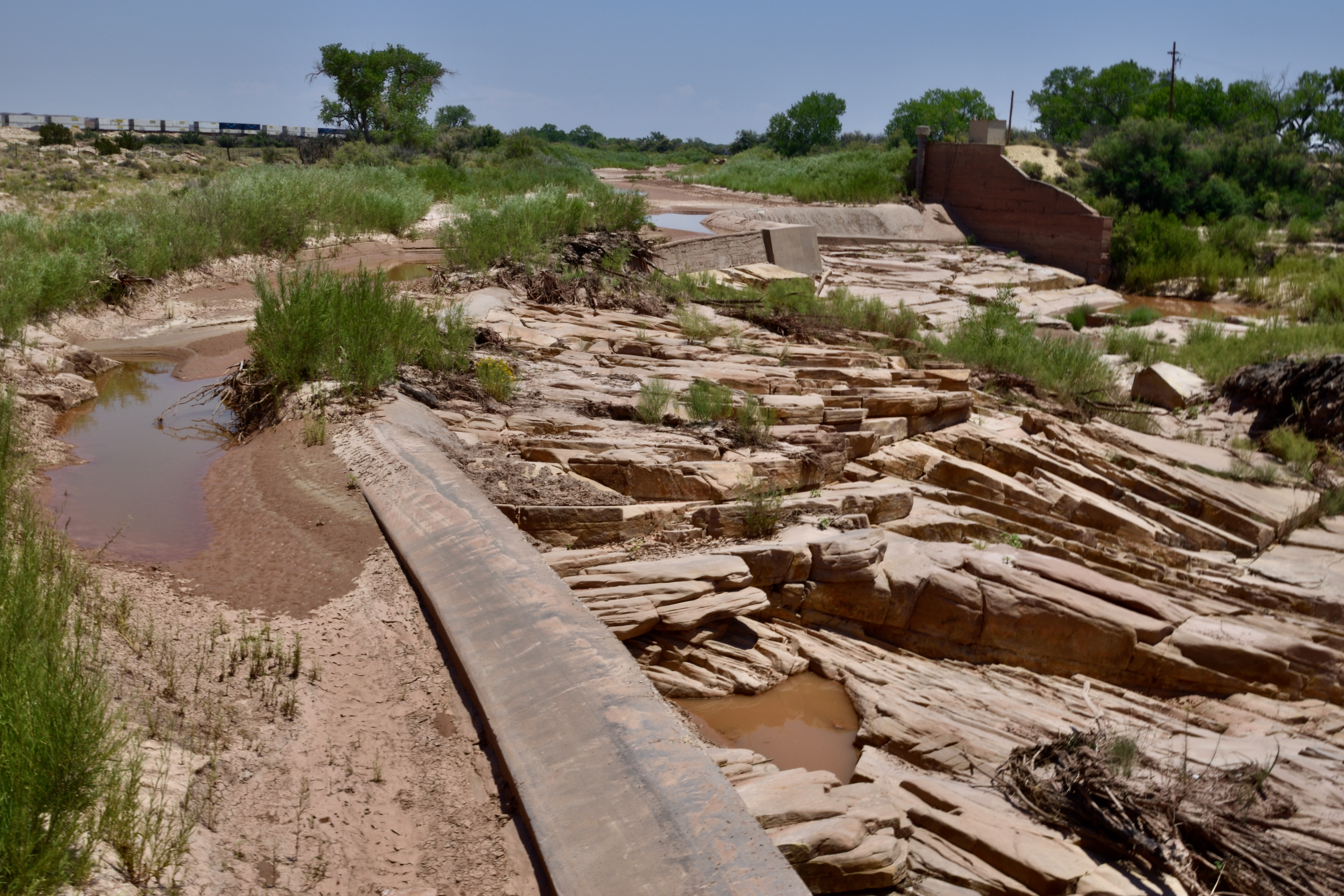
. . . brought early pioneers to that seemingly barren wind-swept country when they diverted water from the Little Colorado River to grow crops needed to feed themselves and their livestock.  That enterprise was indeed daunting in 1876 - incredible that they rebuilt numerous times when the structure washed away in floods.


With wills many of us can scarcely imagine, they constructed one diversion dam after another each time storms washed one out.  After a good bit of research assisted by Chris, Lewis tracked down the dam's site and was anxious to share it with us.

We saw where the dam diverted river water to a large ditch engineered to deliver irrigation as needed near their settlement. . .


 . . . and shortly after our visit, a storm brought the river to life, a scene that Lewis captured well to show how water is diverted into the ditch while the main stream flows by.


Here he’s checking out a mechanism that opens the gate to allow water into the ditch. . .

. . . and here they are . . . not really sure what they are doing.

 Trailblazers . . .

In the larger scheme of things, much of Arizona, and the Southwest in general, remained unexplored long after most of the continent.  Eventually explorers and pioneers in northern Arizona managed to find their way through harsh countryside, seeking viable passages and places to put down roots.

A plaque and bas relief I spotted in Winslow commemorated some of those route-finding & road-building ventures beginning in 1853. . .

. . . while other sites recall the region's history, in this case, the 1876 establishment of Joseph City, originally called Allen's Camp for Capt. William C. Allen, who led the small band of Mormon pioneers.  It is the only remaining town of four originally settled by LDS members in that area; the others were Obed, Brigham City & Sunset.

Serendipities . . .

As we were dining at a local Mexican eatery in Holbrook, Lewis mentioned that across the street was a mural that tourists visited for photos.

We stopped by to see what the attraction was: the historic Route 66 was mapped on the building’s side, and photos were the name of the game.


It was there we saw a young couple with their youngster, and I offered to shoot a photo of the three of them.  Realizing from their accents that they were foreign, I inquired about their origin: they were from Poland.  We chatted a bit and went on our way.

Later, we were relaxing poolside at our motel where a young boy was splashing happily with his mask and snorkel.  What a shock when we stood up to leave, walked around a corner and saw the same couple who were staying at “our” motel.

That serendipity loudly called for a follow-up; we sat and happily got acquainted with Marek, Karolina and their sweet son, whose name translates to Blaize (I think), the Polish version is lost to me.

How fun to meet that lovely family and to be able to stay in touch.  They told us all about this trip (their second time in the U.S.) and their plans for touring the Southwest.  They had already been to several Arizona sites, and Karolina was in love with our great state; she extolled at length about Arizona’s beauty and variety, clearly very astute.


Out ’n about . . .


Lewis appears to take after us with his love of gardening, as do both of his siblings.  His peppers and tomatoes are thriving alongside his cute yard/patio.


It’s not unusual to see dust devils in the Southwest desert, but these may have been the granddaddies of them all.