Wednesday, March 18, 2015

It’s spring break, baby!
March 9, 2015

Oh yes, it is spring break and I am reveling in the awayness of it all - away from chores, away from jobs, away from all the expectations I put on both of us.  Not very long ago, spring break was a neither-here-nor-there event for us.  That was before I went back to work at Yavapai College.  A job - part-time and temporary though it may be - changes everything.

There’s something about needing to be present and at least semi-alert at 8 a.m. five days per week and to remain in that state for four hours that creates a framework for all other facets of daily life.

Truthfully, I am grateful for this job while at the exact same moment hoping that someone will give me a reprieve.  I am returned to the same YC department from which I retired quite some time back.  Then I was honchoing the program for lifelong learners; now I am the flunky.  I am quite enjoying reconnecting with lots of folks of whom I am very fond; the new complex computer system - not so much.

Between us, Chris and I have managed to keep up a fairly hectic pace for a spell - he is handy-manning, playing and writing music, teaching and leading field trips, and I have had a passel of genealogy jobs, my b&b and the job, and on Sunday afternoon, we completed our first co-teaching endeavor - a four-class course of English country dance, thus spring break is a welcome respite.

And ever so nice that we have another free RV camping stay at Emerald Cove just across the Colorado River from Parker, Arizona.  Our trial membership allows us a total of 20 nights camping to be taken in four-night increments; this is our second time out.

Instead of arriving at the office, an 8 a.m.Monday departure transported us in three and one-half hours from a chilly morning at home to shorts- and tank-top weather in the desert on the shore of the Colorado.

Crashed . . .

Happy to get an early start and thinking that after trailer set-up, a good half-day of activity awaited us, instead we were so exhausted that we took naps.  Holy moley - not my idea of how to spend vacation time or any time, for that matter, but truthfully, I couldn’t rouse myself from my somnambulent state.  Eventually, when all I really wanted to do was to sit in my beach chair on the river bank with a Margarita at hand while staring blankly at the water, Chris harassed me into getting into the truck for an explore.

Residual tension and fatigue seemed to put us both at our snarky worst during the drive hither and thither until the universe stepped in to get our adrenaline flowing and give us an attitude adjustment via a startlingly large and beautiful bird flock undulating overhead as one, spiraling first one direction and then another as if perfectly choreographed and rehearsed.  No place to pull over on the narrow winding road to try to see what they were, and then they dropped out of sight. 

How excited we were, then, to happen upon their destination in the course of their circling low over a backwater to settle in for the evening roost.  I snapped a few photos as they jockeyed for position; the binoculars allowed us finally to determine their identification - white-faced ibis, estimated at 600ish in number.
The ibises broke ranks as they jockeyed for land & water positions.
The following day, we found them again at that spot, calmly grazing for whatever delectables they could dredge from under the water with their long curved beaks.  They were amazingly subdued for a flock of such size, just a few quiet little noises as they took their evening meal.  Some among them were adopting a raised-wing stance.  I wondered if it was some sort of dominance thing; however, it was not accompanied by any squawking or other aggressive behavior and was pretty much ignored by the others.


That excitement and attitude adjustment aside, we began to peruse the pond area and an adjoining water hole and found coot, mallard, marbled godwit, green-winged teal, least sandpiper, common goldeneye, northern pintail, canvasback, ring-necked duck, snowy egret, ruddy duck, black-necked stilt and great egret.  These added to the few we identified on the drive over: turkey vulture, spotted towhee, raven, northern harrier and phainopepla.


Music, amenities . . .

We enjoyed a few late evenings of getting out the keyboard so Chris could make music outside, which was enjoyed and appreciated by the neighbors.  That is always a good way to meet folks; it paves the way for them to stop over, listen and visit.

One of the things we enjoy about RVing is preparing our own food while traveling; however, Emerald Cove’s Tiki Bar makes purchasing meals almost irresistible.  The food is quite good, the prices absurdly low.  We made it home in time one afternoon to enjoy their excellent quesadillas with sour cream, guacamole and salsa, all for a whopping $2.19.

The swimming pools - one under cover, one open to the sun - are nicely maintained and the large spa is sublime.


“CRITters”, Ahakav . . .

The town of Parker and much of the surrounding region is reservation, belonging to the Colorado River Indian Tribes, characterized on numerous enterprise signs as CRIT.  Chris wondered aloud if the tribe is known as CRIT, would its members then be Critters?  I’m guessing probably not, but the question hangs.

Reading about something on the reservation called the Ahkahav Preseve and experiencing the reality turned out to be worlds apart.  Online literature convinced me that by going there, we would enter a riparian paradise; we anticipated strolling leisurely under green leafy trees alongside the water and hearing bird song all around us.
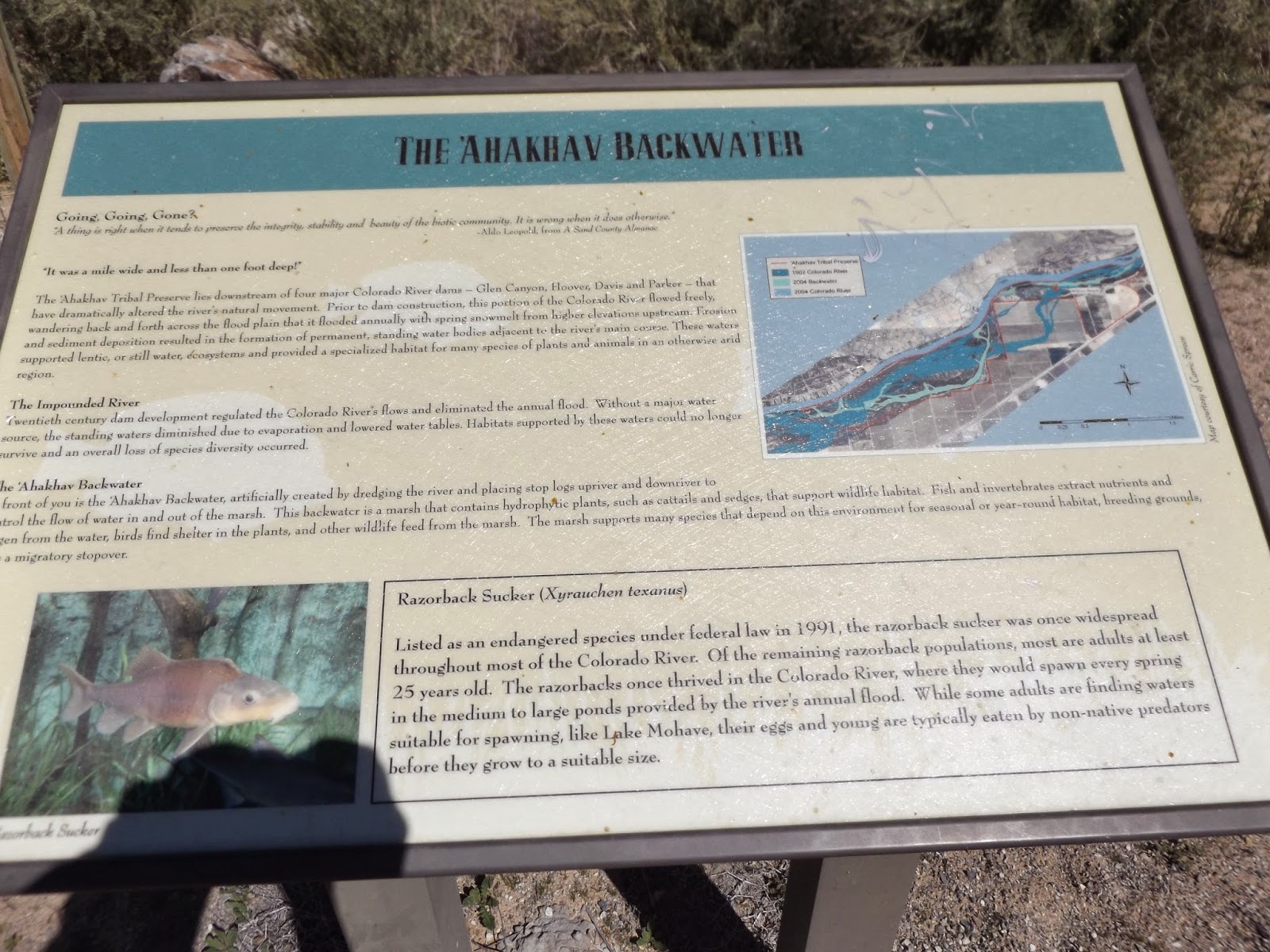

First off, finding the place was a major challenge: we did three turnarounds because the directions were so obscure as to be impossible to follow.  Eventually, we did find it, but only accidentally after giving up and taking a back road to see where it led us, then wandering in without even knowing we were there.

Second, the preserve, while fascinating in its own way, bore next to no resemblance to my expectations.  It is clear that I read into the description something more than what it actually said.  It serves as “a revegetation area for endangered and threatened plants and animals native to the Lower Colorado River Basin.” 

Ahakav consists of a small developed park (near the entrance which was in our case the exit) and more than 1,200 acres of basically thick thicket (just wondering - can a thicket be thin or would it then be a thinnet?), almost all impenetrable brush following the serpentine route of a side channel of the Colorado River.  Evidently, the inflow is controlled in order to maintain the environment for the wildlife and avian species that are there.

We found a couple of places where we could get out for short walks and saw a black-tailed gnatcatcher to add to our trip list.  The bulk of the brushlands was dry and in the few places we could get close enough to the channel to scout for birds, they spooked away at our approach.  We did manage to get roadrunner, yellow-rumped warbler, cinnamon teal, northern shoveler, green-tailed towhee and red-tailed hawk.

The place has great appeal as a perfect place to fish from the kayaks; we will likely do that on a future stay here.  Again, we did not bring the boats with us because over-the-head weight-bearing motion is the one thing Chris’ shoulder-sans-rotator-cuff is not yet ready to tackle.


Agriculture . . .

The search for the Preserve took us out into the extensive Parker Valley acreage devoted to agriculture.  Many of the fields were planted to some type of grass destined to be baled for hay; however, random cotton plants on ditch banks revealed that it is a common crop there, too.


I thought the lush grass might be sudan, but Chris who is more knowlegeable on the subject, was not able to identify it.


Large canals and ditches carry irrigation water to the fields, without which there would be no farming in that arid region.


With water and without…

Wyatt . . .

We were camping on the western side of the river, thus on the opposite shore from Parker, Arizona - in Earp, California.  I'm still trying to determine where the town of Earp actually is; all I saw was a strip of developments following the river bank in one direction, and in the other direction, a post office that appears to have been built about a hundred years ago across the road from a garage.  This leads me to believe the post office is the sum total of downtown Earp.


Its water supply appears to come from a nearby tank that carried a welcoming message, my second clue that the location truly is Earp.  I knew that the (in)famous lawman had lived and ultimately died in Los Angeles. so I quickly poo-poohed the idea that he had resided in Earp, but research proved me wrong.


After astutely googling the question, "Did Wyatt Earp live in Earp, California", I found the truth according to Wikipedia:

"The town, originally named Drennan in 1910, was renamed Earp in 1929.   It was named for famed Old West lawman Wyatt Earp who with his common-law wife, Josephine Sarah Marcus, lived part-time in the area beginning in 1906. Earp staked more than 100 copper and gold mining claims near the base of the Whipple Mountains.

They bought a small cottage in nearby Vidal and lived there during the fall, winter and spring months of 1925 – 1928, while he worked his "Happy Days" mines in the Whipple Mountains a few miles north. It was the only permanent residence they owned the entire time they were married.  They spent the winters of his last years working the claims but lived in Los Angeles during the summers, where Wyatt died on January 13, 1929.

Though the town was never incorporated, the post office near Earp's mining claims at the eastern terminus of Highway 62 near Parker, AZ was renamed "Wyatt Earp, California" after Earp's death in 1930 with a ZIP code of 92242. For amusement only there is a tiny cemetery showing the fake grave of Wyatt Earp."


8 miles - dogs ‘r barkin’ . . .

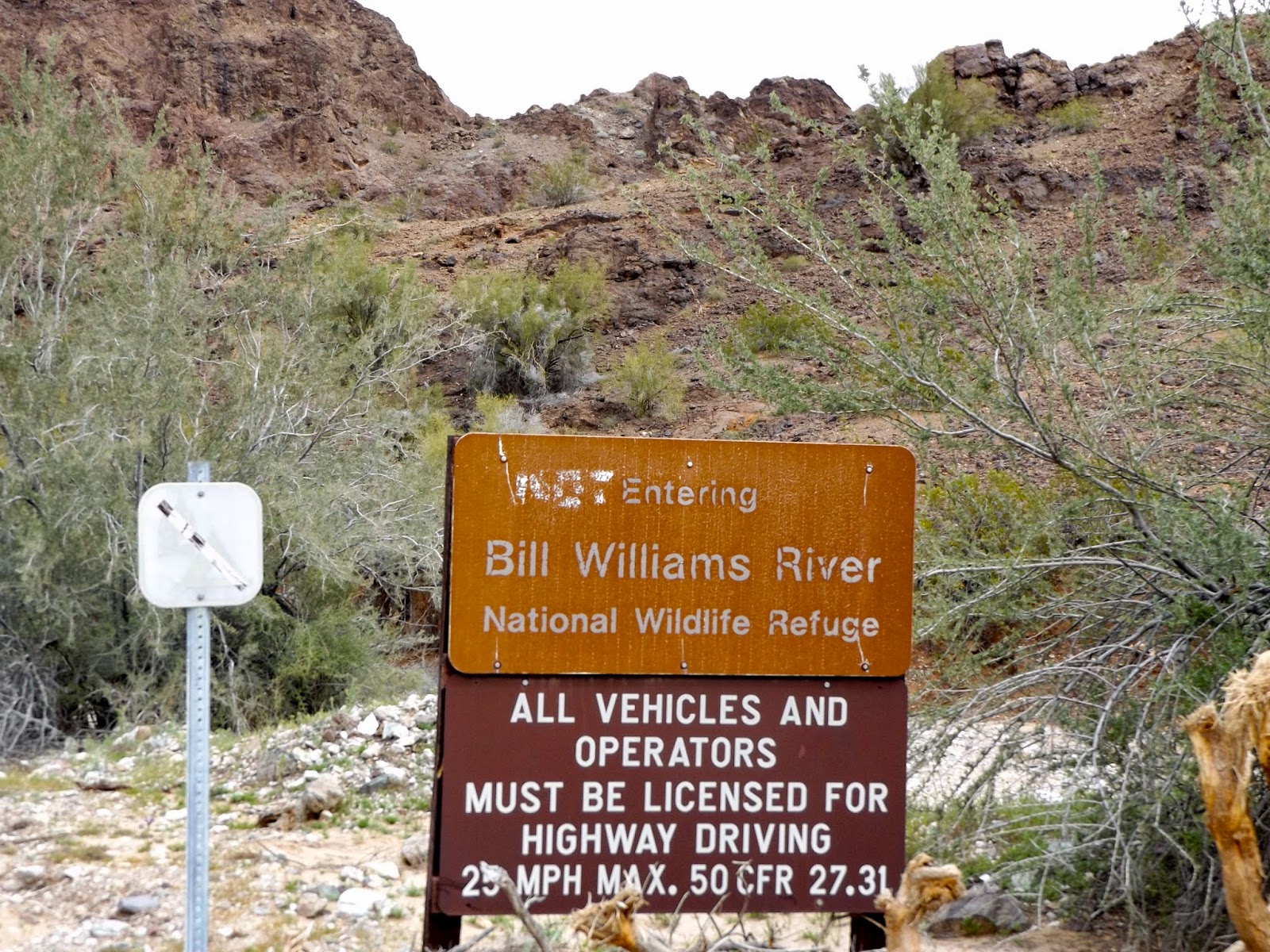
Destination: the Bill Williams River, access unknown.  When we were at Emerald Cove last month, we went to the ghost town of Swansea and reckoned that father along that same route would get us to a section of the river that we hadn’t visited before, so this trip was the time to do just that.

With lunch made and packed, we embarked on the drive, but stopped at a spot where the road appeared to be iffy up ahead and determined to hike the rest of the way - a couple of miles by the señor’s estimation.  Not being of a mind to abort an activity short of its fulfilment, we continued on a good bit beyond the expected arrival, and what a hike it was!

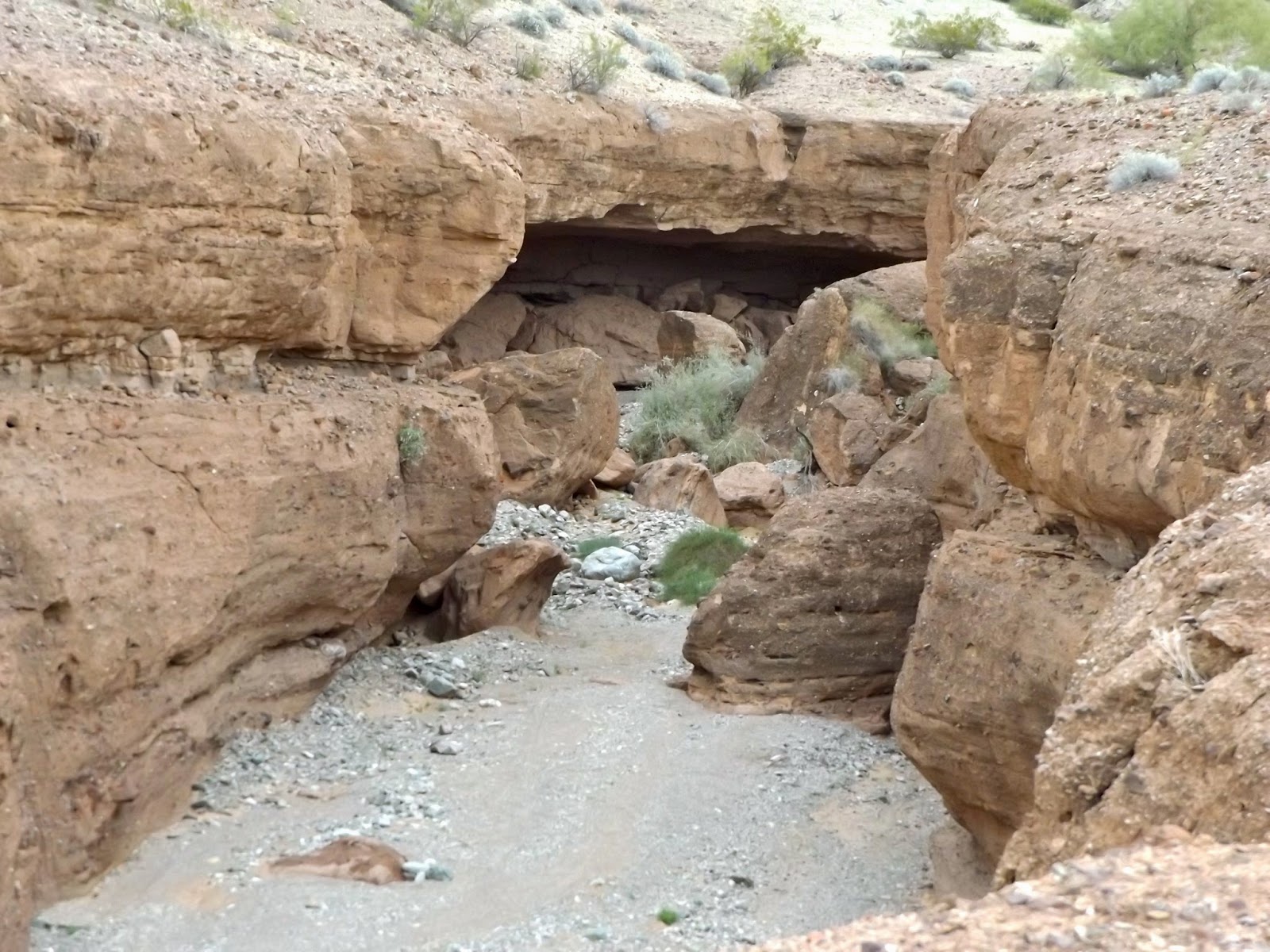
Right at the start, we walked the bottom of the most amazing convoluted canyon and continued on through country created by crazed geologic cataclysms.




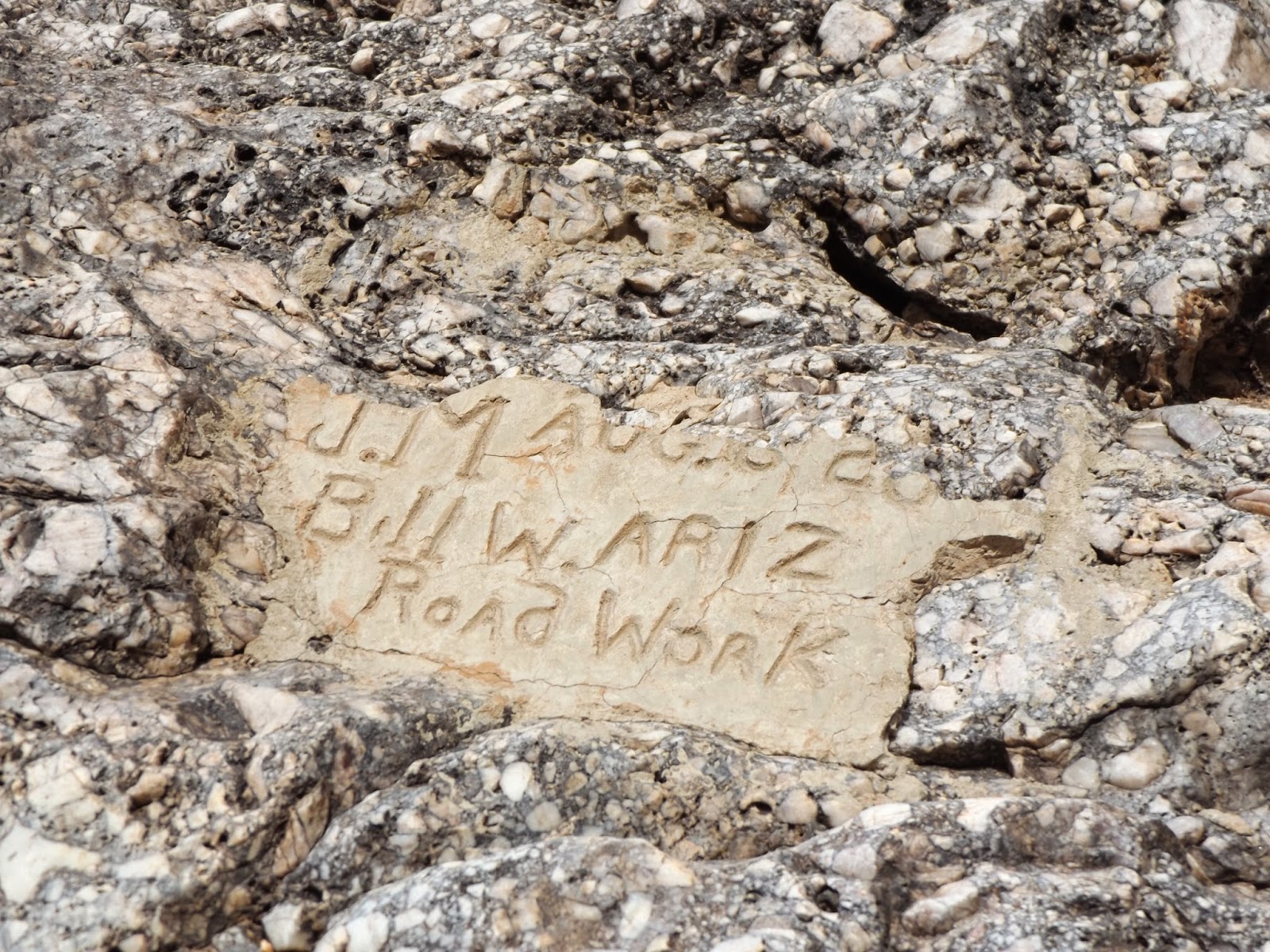
We found this remnant of a concrete inscription along the way, not sure of its purpose.  There was much evidence of abandoned mining activity in the surrounding mountains.
I couldn't resist bringing home this fabulous veined specimen because I…really…need…more… rocks.
Each curve of the canyon revealed more unexplainable combinations of rocky cliff faces, each scene more tortured and twisted and beautiful than the last.  Spring rains had brought forth some flowers, more appreciated because of their scarcity.


Along the hike, we identified rock wren, house finch and cactus wren, not much of a showing for eight miles, eh what.

Perseverance paid off as it is wont to do: we made it to the river, a startling contrast to the dry canyons and sandy washes surrounding it.  The riparian area was nothing short of magical - one beaver dam after another all along the course of the waterway pool up the flow, backing up water into side channels choked with reeds, willows and myriad varieties of greenery, a lovely spot to enjoy lunch and watch for birds.


This section of the Bill Williams has little free-flowing stream; beavers have claimed extensive sections as their own.  The mountain man for whom it is named would surely have great results if he were to set out his traps now.


Two channels of the river are widely separated by a dried-mud flat of impressive depth.
We heard lots of avian calling and chattering, but it was difficult to identify the species flitting among their leafy bowers.  We did get black phoebe, ruby-crowned kinglet, Gambel’s quail and canyon wren, in addition to a great blue heron that silently glided away from its fishing pool just ahead of our approach.  Our only life bird on this trip was a warbling vireo that was busy at its appointed rounds in the cottonwoods and willows overhead.

We worked our way through the brush in the few places we could force our way, sometimes walking crouched over to find access to the water, and headed back sooner than we would have liked because of the long hike out.  Now we know the road is drivable all the way to the river - next time, we will do that and leave more time for exploring the water course, and return home less fatigued.

Four miles in necessitates four miles out.
Birds . . .

We enjoy identifying birds wherever we go; that area of the Colorado River flyway with so much migrating and seasonal avian life tends to make it irresistible.

Other than those already noted, we got mourning dove, great-tailed grackle, red-winged blackbird, collared dove, Brewer’s blackbird, house sparrow, double-crested cormorant, pied-billed grebe, rock dove, starling, and black-chinned and Anna’s hummingbirds (yes, they finally found our feeder).

Regrets . . .


So anxious were we to be departed from work to relaxation that we never managed so much as a phone call to  Corina, much less gathering enough energy to make a plan.  Everything that happened was simply the result of getting in the truck and seeing where it took us, so we missed a visit with that sweet girl and are sorry to have done so.

Loon, palm canyon, fish or not, burro . . .

Yet another day of wandering aimlessly allowed us to crane our necks not to miss one bit of more miles of spectacular scenery - more mountains contorted into impossible shapes with the canyons between peaks begging to be hiked.  After our previous day’s eight miles, hiking was kept to a more moderate distance.

One short walk allowed us a vista of a palm-filled arroyo of stupendous beauty.  There were at least three varieties of palms in the canyon bottom and reaching up into side drainages, gorgeous in their masses and especially in contrast to the backdrop of dark swirled rocky cliffs.

We were excited about climbing down in for an explore but were deterred by the brushy bottom, not to mention the signage declaring fines and jail time for trespassing.  It was not posted at the point where we climbed, but we could not deny knowledge of threatened action by signs below.

While winding our way down a dirt back road, we encountered a wild burro.  This one was a country burro, unlike those in-town moochers that graze in RV parks and wait for tourists to arrive with carrots.  He stood still for a bit of an ear-scratch, but soon shied away.  What other wild animal could a person do such with?


We stopped long enough near Parker Dam to make a stab at fishing, the end result being a nice snooze in the sun (I wasn’t kidding when I said we were tired).  It was most relaxing except for the excitement when Chris caught a three-inch bluegill.  Somehow, it just did not measure up to the two-foot striped bass a nearby fisherman told us about. . .

Even  more exciting, though, was when I spotted a common loon floating on the water.


So what if I called it a cormorant at first - in my defense, it was very far away at the time.  It was only the second one we’ve gotten; the first was on Lake Mohave nearly 20 years ago.  I have a cute photo of that earlier one with Rowdy perched on the houseboat rail watching the bird bobbing on the water.

Prescott is not the only place with a "P" mountain; Parker's is bigger, though, presumably because it's much farther from town.
The Parker Valley, through which the Colorado River flows on its way to the Sea of Cortez, is ringed by numerous rugged and majestic mountain ranges.

I did not previously know that California pumps water out of Lake Havasu.  These aquaducts are part of the system that delivers the water to yet another reservoir higher up.
Best sign on an RV.


Monday, February 16, 2015

The spice of variety, boylessness
February 2, 2015

A change of scenery is just what we ordered after a few months of doing what the doctor ordered, and glory-be, that is what we got.

Since our short little Thanksgiving trip up Kingman way, we found ourselves in a maelstrom of medical miasma.  Chris’ shoulder surgical site was infected to the point the surgeon needed to perform a second surgery to clean it up.  That procedure showed that the rotator cuff repair had failed; four days of hospitalization ensued, followed by six weeks of daily intravenous antibiotics and a rousing round of physical therapy that is still continuing.

We have now become far too well acquainted with a variety of medical professionals who are, to a person, as nice as can be; however, I have had it.  End of patience with all things ill, when along came an opportunity to get out of Dodge without expending any hard-earned cash - irresistible!

A reinstated (long, sad story) trial RV resort membership in a place of  climatic warmth not very far from us at all paved the way for us to put home in the rear-view mirror for a spell.  And that is how I found myself sitting outside the trailer chatting with neighbors while Chris played away on the keyboard, that particular outside being on the California bank of the Colorado River near the town of Parker.  Scattered palm trees and occasional oleander hedges attest to the clime’s temperatures more moderate than those in Prescott.

That was our first RV trip sans “the boy”.  Rowdy and his feline needs were such an integral part of our trip preparation and routine that the lack of it has brought the grief at losing him to the forefront, necessitating a bit of a cry-fest upon arrival.  Admittedly, the travel routine is simpler in his absence, but then easier is not always better.  In his 19 years, he certainly managed to ensconce himself into a permanent heart space.

Yarnell Hill . . .

To attain our goal, we could have taken the longer but faster route northward through Kingman and arrived via a an Interstate highway stretch, but opted to wind our way down from the mountains via Iron Springs and Peeples Valley.  That steep curving route necessitated my admonishing Chris to take it slower, all the while he was driving at a safe and prudent speed.  Not exactly white-knuckle as some places we have taken the trailer, but sufficient to keep our attention on the road.

Emerald Cove . . .

We encamped in dedicated snowbird country.  RV parks, resorts and camp sites abound - those homes-on-wheels are everywhere on the roads in these parts - all sizes and types are here at the behest of their northern-dweller owners who are thawing out instead of freezing their tushies off in Minnesota, South Dakota, Oregon, Idaho and other inhospitably frigid places. 

The park is adequate - level gravel pads, picnic tables supplied (I dislike the places that don’t have tables for each space because I prefer to eat outside whenever possible); the siting right on the Colorado River is the big draw, as it is with the many-miles-long string of private and government-managed parks interspersed with side-by-side waterfront private homes.  Owning one of those is something I could get behind without hesitation.

Our park’s waterfront is a long sandy beach where residents park their boats.  Chris’ shoulder situation precluded our bringing the kayaks this trip, but another time, we might do that.
Although we spend little time at “home” in the park, we did manage to enjoy the very nice spa.  That and the pool adjoin the open-air bar and restaurant, an eatery with good food at dirt-cheap prices, prices so low it almost negated the advantage of getting a free dinner as part of the package for sitting through a sales spiel.

The loot . . .

We were at Emerald Cove only because of the loot we were offered - and a generous package it was.  First off, the four-night stay was free of charge and $200 gasoline credits more than paid for our transportation.  In addition, we were given an Android tablet (wondering if we can sell that?), the dinner, and a $200 two-night stay at a five-star hotel.  And . . . we get four more four-nights stays during the year.

Well shucks, I can spend 90 minutes listening to almost anything for that; as it turned out, we made it clear from the get-go that we were not buying a camping membership, so instead of a high-pressure megillah, we had an interesting talk with a nice woman who happened to be the same age as our oldest son.  How in the world do these adult people end up the same age as our children!?  It’s all very disconcerting when I am reminded that I’m one of the gray-hairs now.

Winterizing . . .

Admittedly, there is substantially more to be done to take the trailer out during the winter, which is why we never did it with the old Totee and why it would be preferable to have the opportunity to be gone longer now.  First we have to un-winterize the rig when we get there and re-winterize it before we return to our colder clime.  These are not world-ending chores, but do take up more time than fair-weather RVing.
 
Parker Dam was an interesting stop.  We hiked from one side of it along the shore of Lake Havasu.  The lake's water level comes very close to the top of the dam which is also the highway.  I had hoped there would be interior tours, but no such luck.
Bliss . . .

Without a doubt, the highlight of this sojourn was a visit from Corina, the baby I midwifed 30 years ago in Chino Valley.  She lives in Lake Havasu now, near the RV park, and brought her sweet new little one to spend  an afternoon and evening with us. 
I believe that adorable child was actually taking my opinion into consideration.
Corina’s mother and I were partners in a landscaping business lo these many years ago after having been neighbors.  She attended the home births of my two youngest and I was honored to not only reciprocate but to be her midwife.  The euphoria of that day will never fade from my heart.

What fun it was to see first-hand what a fine young woman Corina has grown to be, especially because she has always felt like one of my own, and now I see what a good mother she is to her charmingly cheerful little one.

Impermanence . . .

From our here-and-now human perspective, a town of more than 2,000 people with all the necessary markets and services seems to be a permanent fixture on the landscape; however, when its raison d'etre ceases, the population shrinks rapidly and the structures left behind fall into forlorn decay.  Such is the case of a 1930's-era village called Cross Roads that we ran across.

The town site, near to our RV park, dissolved quickly whence it came, although a handsome rock ruin of the Cross Roads Mercantile Co. stands still to mark the passing of the era of dam construction.
On another of our explores, we ran across a prehistoric archaeological site on a rise just over the river and saw a few potsherds scattered here and there.  Walking downriver from there brought us to the remains of what we guessed might have been a bridge or ferry landing.
Birding . . .

As is our habit, we always put out seed and nectar feeders to attract whatever birds are lurking around the park, and so we followed that routine at Emerald Cove.  Much to our astonishment, we attracted nary one finch or sparrow, never even saw either of those usually-plentiful species.  That has never happened before. 

Not surprisingly, grackles gathered right away but were unable to land on the feeder, so gave it up except for an occasional comical bird that would stand under it looking upward and waiting for manna from heaven.  One highly evolved female figured out how to cling to the pole and reach over to snatch a seed, but evidently deemed it more trouble than it was worth.

Even the red-winged blackbirds that will often mob a feeder passed it by after a few glances.

Although there were few birds on the main river channels, some of the still backwaters were teeming with avian life.  A slight issue with the scope caused us not to be able to utilize it when it would have helped the most, but even without it, we identified a goodly number of species.

Besides the ones already mentioned and ravens, turkey vultures and Brewer’s blackbird, we saw the ever-present coots and great blue herons, in addition to pied-billed grebe, California gull, mallard, common goldeneye, canvasback, double-crested cormorant, lesser scaup, bufflehead, ruddy duck, northern shoveler, great egret, ring-billed gull, snowy egret and killdeer.

On one hike, we spooked out a northern harrier that swooped low out of his brushy hideaway.  The country thereabouts often consists of a salty semi-barren landscape, interspersed with thickly vegetated areas that are home to a plethora of bird life.  Some that we spotted in those area included bushtit, blue-gray gnatcatcher, yellow-rumped warbler and black Phoebe.  Despite the complete lack of finches and sparrows, rock doves (pigeons, that is) gathered by the dozens on rooftops in town and we saw one Anna’s hummingbird in the brush above a river beach, although none of that species visited our nectar feeder.
Phainopepla are plentiful in that arid clime.  I love hearing their call and spotting them in their favorite type of perch - at the top of their chosen tree or shrub.
Burros . . .

As plentiful as sand buggies and tourists in that country are the so-called "wild" burros.  They are feral, true, but one could hardly realistically label them wild.  True to their gentle nature, they have become so accustomed to people that they simply wander in and out of yards, RV parks and anywhere else that offers a tasty graze.
Yup.
Please note the headless animal - curiouser and curiouser.
We are admonished not to feed them, but it is obvious that some of them have come to expect a handout.  One black beauty saw us stop for a photo and trotted right on over for his treat; he settled for a good long head- and ear-rub in lieu of an apple.
Burros have always been one of my favorite beasts.  Dad often bought and sold wild donkeys which my cousin Johnny and I enjoyed.  Even those that had never been around people would gentle down right away.  One of our favorite activities was to loop an old fan belt over their necks and hop on for a ride.  The creatures would sometimes tear off down the pasture, but seldom bucked like a horse with its first rider and even when they did, it was mild enough that we could generally remain aboard.  The times we lost our seat were not too damaging anyway because the animals' easy way and their short stature gave us not far to fall or to be flung.

To this day, I cannot resist rubbing their big ol’ thick ears and giving them a good head scratch, sweet animals that they are.
This mama warned me off from approaching too closely to her baby by laying back her ears.
Swansea . . .

Visiting the ghost town of Swansea has been on my agenda for years; now it can be marked off.  The site is far off and gone from anything else other than many miles of desert and mountains, an isolated place not too distant from the Bill Williams River.

After we departed from the highway, we were somewhat taken aback to encounter people, RVs, dune buggies and vehicles of every ilk - hordes and hordes of them.  Putting the proverbial two and two together, we at last determined they were there to spectate some sort of off-road rally which seemingly had not yet begun.

In preparation, though, many of them had lined up along the dirt road lounging in chairs.  It made me feel as if they were waiting for a parade and I was it.  I tried to get Chris to slow down so that I could employ my queen wave to my admirers, but he was uncooperative.
For this, I have no words . . . why this craft was sitting out there with its sail up and surrounded by RVs in the middle of the desert is quite beyond me.
As always, the journey holds much of interest.  One such curiosity stop was to climb a sand dune that seemed to be completely out of place.  All the ground thereabouts was of a dark hue and rocky, yet there was a large sand hillock that required a stop and look around.


The fun of boondocking is in never knowing what will show up.  Sometimes, the prize is vast expanses; other times it's in the details.  I love exploring without expectation, just being open to whatever presents itself.

This stumped us both; it is some kind of plant skeleton, but no idea from what.

Expecting to find nothing but foundations at Swansea made the reality so much more exciting.  I had no inkling how extensive this town had been - everything from a hospital and a railroad station to a dairy and a smelter and lots more in between.
A sure bet: Abandon a vehicle and it will get shot up.  This truck looked as if it were bleeding from the bullet holes.
Unique to this former village, the Bureau of Land Management has done stabilization on some structures; a bonus is signage throughout the area explaining the use and date of many of the buildings.

Our day involved substantial hiking: Swansea covered a large area, and I wanted not to miss a thing.  Even so, we departed with the idea that a return trip is necessary; in fact, I'm thinking even more than one reconnoiter is in the future.  I want to spend more time at the Swansea site itself, and I would love to continue past it to the river beyond.  On an earlier trip to Lake Havasu, we kayaked the upper lake and as far up the Bill Williams River as we could force our boats.  Getting to the waterway from the Swansea road would allow us to see another part of the channel.
Ruins of the Swansea smelter.


Without support, the remaining railroad station walls would have fallen into dust.
The railroad ties are slowly but surely being reclaimed by the earth.
This was exceptionally interesting, something we had never seen before.  A lengthy berm, perhaps a half mile long, had been built so that a train could pass the station and move onto a train-car-size scale, the remains of which are shown above.
This line of adjoining rooms has had some restoration work.

I've had days when I felt like this . . .


This adobe wall will not withstand much more weathering.
For reasons unknown to me, molten slag was allowed to solidify in the smelter cart and then discarded as a cast of the cart.
Dump diggers delight - acres and acres of it.

Many of the area's mine shafts were firmly secured against accidental or intentional intrusion, while others remain open.

This huge rock bridge is one example of some mighty convoluted stony formations thereabouts.

The Bill Williams River course crosses in front of the distant magnificent mountains.
 

Crossing the Central Arizona Project canal required a stop to admire all that water and to discern what birds are riding the current.  In this case, it was buffleheads.

The Gibraltar Mountains from the river side . . .
 . . . and the dry side.  Either way, they want to be explored by me.