
March 5, 2017
Granted that the bulk of our time away was not particularly warm in the weather department and granted that snow in the mountains in February is not at all surprising, but some part of me was hoping that the season had magically transformed during the month and we would return to fragrant blossoms and balmy temperatures.

Alas, the reality, although lovely to look at, was somewhat jarring. Our timing was good, though: the roads were clear and the wind not too bad for pulling the trailer home.
Willcox . . .
Our final stint out was in Willcox, known as the home of "The Arizona Cowboy" - Rex Allen. That claim to fame is wholly insufficient as an economic stimulus; the town is a faded shadow of its former self, although perhaps the burgeoning vineyard/winery enterprises in the Sulphur Springs Valley region may provide a shot in the arm.
Speaking of wineries, our prearranged rendezvous with friends Gail & Normand led us to the Zarpara Vineyard & wine tasting room, where we indulged ourselves in a reprieve from the wind and dust to sample the offerings.

 |
| We three sipped while Chris helped himself to a guitar parked in the corner. |
 |
| Okay, so I forget the dog's name (was it Tillie?), but she and Normand forged an instant friendship. Look at that tail wagging and those love-fillled eyes. |
 |
| One of the more amusing aspects of the Zarpara wine tasting was this picture hanging in the ladies' room. |
 |
| Okay, so we stopped at a second wine tasting room - couldn't help it, really - it was right next door to our friend Casey's house, so she joined us for a late-afternoon session. |
Cranes in the wind . . .
The purported purpose of our Willcox stopover was to share the sandhill crane experience. The shallow basins of the playas thereabout fill during the winter, becoming the seasonal home of many thousands of migratory waterfowl.
Sandhill cranes numbering more than 13,000 jostle for position along the wading waterways, departing for surrounding grain fields for daytime feeding. While we were there, the wind seldom ceased, whipping up dust clouds of gargantuan proportions, and creating pretty unpleasant conditions for outdoor activities of any kind.
The steady strong wind evidently affected the cranes' behavior, resulting in little flight activity; the birds primarily stayed put and many even lay down lest they be toppled over (I felt like doing the same - it was blustery enough that I had difficulty holding my binoculars steady).


 |
| Normand kindly located a sheltered corner for our picnic lest it be blown away before we could enjoy it. Note our windblown coiffures. |
As we know, it's all about the journey, not necessarily the destination, and that weekend was no exception. As we wandered back roads searching for birds that were not out there in the fields (despite having the proverbial bird brains supposed to be of minimal effectiveness, they were huddled at their more protected roosts), we encountered several sites of interest.
The 1882 adobe Cochise Hotel is one with which we have more than a passing acquaintance. We were sorry to see that it is no longer open for its original purpose after serving as a hotel and more from 1882 until 2007.
Named for the town in which it sits, the inn originally faced the railroad depot and served as lodging for the Southern Pacific crews, in addition to serving as the Wells Fargo office. The depot is no longer there and the town scarcely exists.
We have lodged there twice and quite enjoyed the unique experience. At that time, the proprietors were two elderly women (remember, the "elderly" designation is relative), Lilly & Liz, who made sure that their customers toed the line. Breakfast was served family style at 8 a.m.; Lilly cooked and insured we didn't miss the meal by rapping sharply at each room door and calling us to the trough.
The parlor was scarcely navigable, it being necessary to wend one's way around the antique furniture that overfilled the room. At the end of the hallway was the original water closet. Although it remained operational, we were grateful that upgraded rooms included private bathrooms. When the water closet developed a leak during the night, Chris rose to the occasion and fixed it.
Big Nose Kate, companion of the equally infamous Doc. Holliday, was employed at the Cochise Hotel at some point after his death in 1887. As I was not present at that early date, I cannot personally substantiate that. Kate (I'm torn between calling her that or Big Nose, but not being intimately acquainted, I opted for the more formal Kate) later lived in Prescott's Pioneer Home, where she died in 1940. Actually, her birth name was Maria Katalin Horony, and she was later known as Mary Katherine Horony-Cummings, but as usual, I digress.
Now a private residence as the general store has been at times, the Cochise Hotel offers a bed & breakfast respite.


Cochise's general store, constructed in 1913, remains standing but not operating on an adjacent corner.

A sad tale in Pearce . . .
Pearce was another waystop, and as bereft of human activity as Cochise. In the same way, private residences have usurped the uses in Pearce's historical structures. A latecomer, Pearce was not established until the 1890s with the development of the Commonwealth Mine's gold and silver.


One preserved historic building in the ghost of Pearce is the "new" jail, constructed in the second decade of the 20th century to replace the original structure. When we see these buildings from long ago, it is difficult to visualize real folks living their real lives in and around them. Since our stop there, I located an interesting and harrowing account of one use of the old jail.
Undoubtedly, others were incarcerated there, but two notable denizens were brothers, William & Thomas Halderman, aged 21 and 18, who were held in the Pearce jail before being transported to Tombstone where they were hanged in 1900 in front of a sizable audience.
The Halderman brothers' saga is one that seems to have escalated all out of proportion to its beginnings, possibly as a dispute over two young women. I will not attempt to relate the tragedy, but offer this link to anyone who is interested: https://en.wikipedia.org/wiki/Shootout_at_Wilson_Ranch.


 |
| We were stumped at discerning the intention of odd "decorations" on and around the Pearce jail. |
 |
| The former Pearce general store is a handsome building now utilized as a private residence. |

Casey . . .
This sojourn has been chock-full of our favorite thing: people - friends and folks in the process of becoming friends. Another of our long-time cherished amigos, Casey, now lives in Willcox, having moved into town from her family homestead, the Riggs Ranch.
She and her friend Fred joined us and Gail & Normand for a little dinner party at the Wuehrmann ranch - the travel trailer. 'Twould have been nice to gather a little earlier in the day; however, an unplanned jaunt to Tucson to replace a slashed truck tire consumed the bulk of the afternoon. In spite of that, a good time was had by all.
 |
| If Casey had not spotted this damage to our tire, I feel sure we would have had a blowout, most likely in a dangerous and certainly less convenient time and place. We have no idea what happened, but were happy that we could access Discount Tire for a replacement even though it was not our ideal way to spend the day. |
We had not been to Casey's house in Willcox, so enjoyed getting acquainted with her new digs and seeing her wonderful studio. She is an excellent, but modest, artisan; I have always been in awe of her work.


We also got a tour of Fred's A-frame house that he designed and built himself, an impressive work in itself. He resides in nearby Dos Cabezas, a settlement of mostly adobes that figured prominently in my childhood, but that's a story for another time.
When Chris played Fred's grand piano, we were astounded at how beautifully the music resonated in the space.

Sulphur Springs . . .
Water being of necessity for human survival, it is not surprising that early settlement always occurred where it was available in one form or another. Many of those locales use the word "spring" in their name, but more often than not, the actual water source has disappeared.
The Sulphur Springs Valley where Willcox is located is no exception. We got to wondering just where the water had bubbled up out of the ground and whether it continued to do so and whether it was sulphurous (seems likely) or whether it was warm. Casey knows her way around that country; after all, her family has ranched there since her great grandparents set up housekeeping in the region, so she guided our quest.
We located the plaque that refers to the two springs and proceeded from there, and a fascinating explore it was.

When we found the bedrock mortars mentioned on the plaque, we knew we were in the vicinity. The depressions had obviously been utilized by early peoples for millennia - there were dozens of them and they were all very deep. I have never seen so many in one place.

 |
| We surmised that this is the spot from which the spring water flowed. |
 |
| This may be the remains of Indian agent Tom Jeffords' headquarters of the short-lived Chiricahua Apache Reservation. |
 | |
| We fell right back into our long-ago routine with Casey of scouting around for anything of interest. |
 |
| I like this and the next shot; they are reminiscent of the following deer pics when they stop to assess whether I am a danger, although I'm fairly certain that Casey and Chris did not feel threatened by my camera. |
 |
| This and the next three were taken on the Riggs Ranch, where Casey's family settled long ago. |


 |
| Look at the abundant graze out there, a clear indication of plentiful moisture over the past months. No wonder there are so many deer. |
 |
| This is becoming quite a large issue in that region because of depleting the aquifer and causing the water table to drop. |
 |
| This mineralized deposit combined with the vibrant hue of lichen for a beautiful sight. |
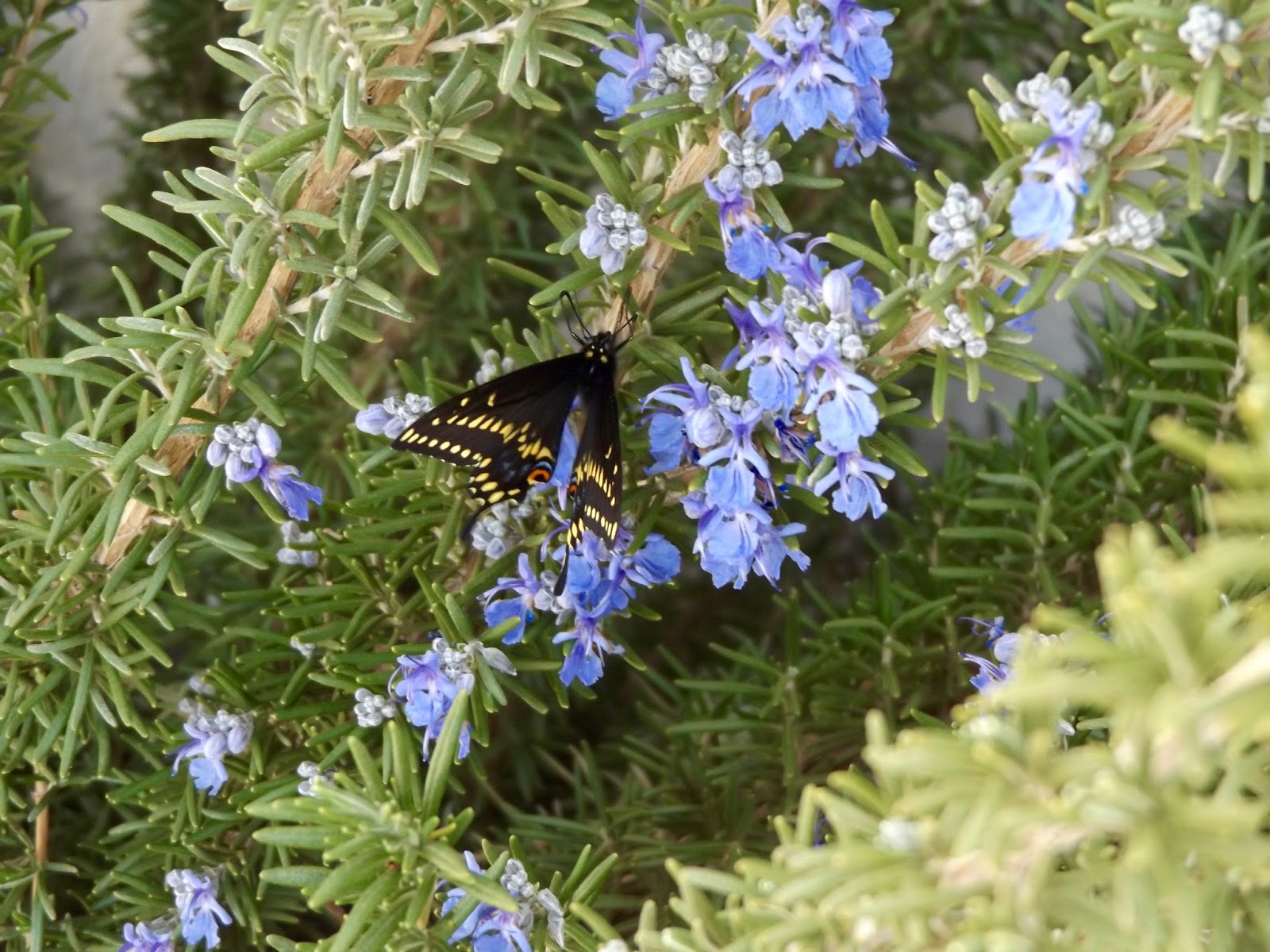 |
| Bowing to the force of the unrelenting wind, this butterfly remained in its sheltered spot on a rosemary plant. It was there when we arrived at the winery and it was still there when we left. |


